The Garrett Inn
Oakland
About 2.4 miles (3 minutes by car) from the lake per the listing.
Check ratesDeep Creek Lake runs under its own set of Maryland regulations, tighter than most lakes: a 26-foot boat length cap, a 30-foot cap for pontoons, a 100-foot no-wake rule along nearly the whole shoreline, an 88-decibel noise limit and a five-hour personal watercraft ban on peak summer weekends and holidays. Here is what the rules actually say, where they come from, and how they change the way a day on the water plays out.
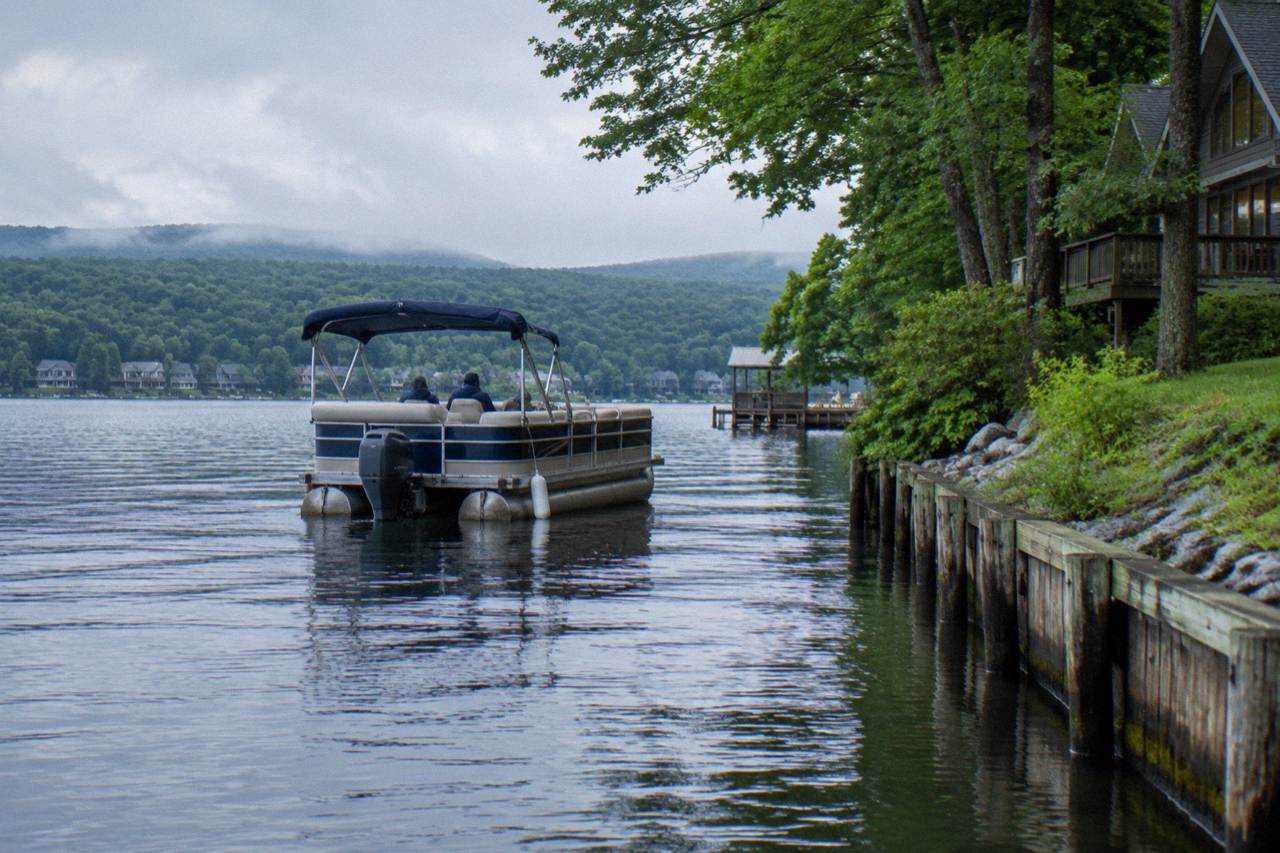
Short answer
Deep Creek Lake boating regulations cap boats at 26 feet overall (30 feet for pontoons), require no-wake speed within 100 feet of shore, docks and other vessels, set an 88-decibel noise limit, ban night skiing, and bar personal watercraft from operating 11 a.m. to 4 p.m. on peak summer weekends and holidays. The rules come from COMAR 08.18.33 and Maryland DNR, and the lake is state-owned water.
Deep Creek Lake is Maryland's largest impoundment, 3,900 acres at a full pool elevation of 2,462 feet, 13 miles long with 69 miles of shoreline, and every square foot of it is state-owned water. That last fact is the reason the boating rules here read differently from a private lake in Pennsylvania or a reservoir in West Virginia. The lake, the lake bed and the strip of land around it belong to Maryland, managed as part of the State park system, and the state regulates the water through a dedicated chunk of the Code of Maryland Regulations, COMAR 08.18.33.02, plus the general Maryland boating statutes that apply statewide. Those dimensions and depths shape everything from where you can ski to where the fish hold, and our guide to Deep Creek Lake's size and depth explains what the official numbers mean for a day on the water.
The practical result is a lake with a hard ceiling on boat size, a no-wake zone that effectively rings the entire shoreline, a decibel meter standard enforced at idle, and summer afternoons when jet skis simply are not allowed on the water. Most visitors never read COMAR. They experience it as a pontoon that feels close to the maximum size, a captain who eases off the throttle near every dock, and a rental shop handing over a safety sheet before the keys change hands. This guide walks through the rules as they are written, then translates each one into what it does to a normal day of boating on Deep Creek Lake.
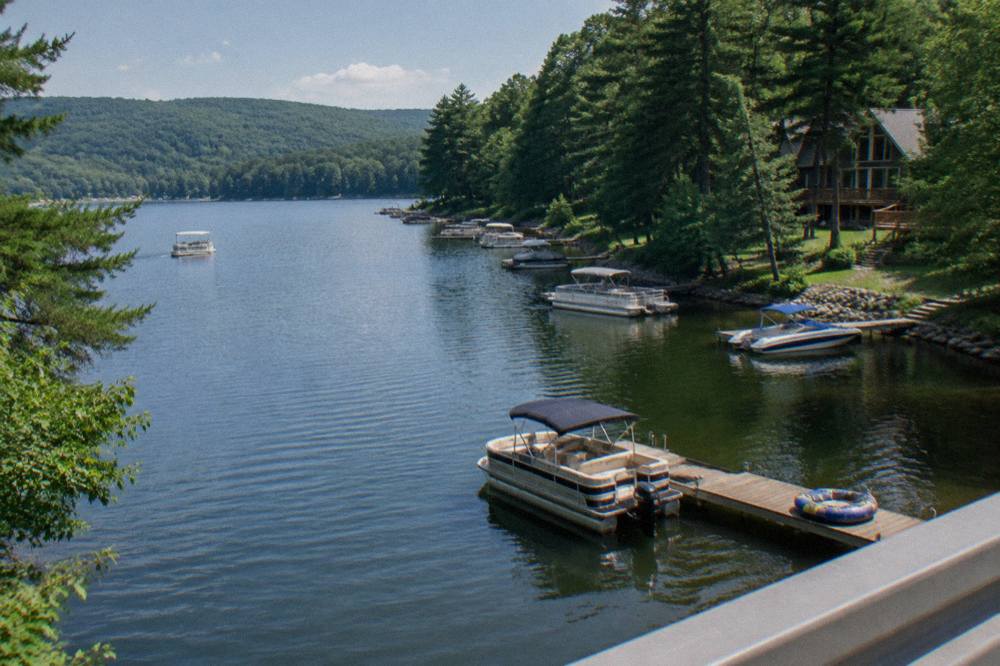
The regulation caps vessels at 26 feet overall length, with two carve-outs: pontoon boats may run up to 30 feet overall, and certain nonconforming or molded-platform boats may reach 27 feet. Engines may not exceed the manufacturer's recommended maximum horsepower, and total engine displacement may not exceed 550 cubic inches. The limits come from COMAR 08.18.33, the Maryland regulation written specifically for this lake.
Those numbers shape the entire rental fleet. When you look at the pontoons available from Deep Creek Lake Boats, which the operator lists on its own page at roughly $450 a day for a 70 HP model, about $575 for 115 HP and about $650 for 150 HP with taxes extra, you are looking at boats built to fit inside the 30-foot pontoon cap and the horsepower ceiling. Nobody rents a giant party barge here because nobody may operate one here. The same logic applies to tow boats: the watersports rentals from Lake Life Boat Rentals, which the operator lists from about $1,296 a day, sit inside the same envelope.
DNR-linked summaries state the molded-platform exception allows up to 27 feet for certain hulls, a detail that matters mainly to private owners trailering a boat in, since it decides whether a measurement argument at the ramp goes your way. If your boat is anywhere near the line, measure overall length including platforms before you tow up, not after. The full regulation text on the DNR page is the place to confirm the exact wording, and it is worth doing: a boat over the limit does not get a warning, it does not go in the water.
For renters, the practical takeaway is simpler. Every pontoon, ski boat and fishing boat in the local fleet is already compliant, so the size rule mostly explains why the lake feels the way it does: big enough for real boats, small enough that the biggest thing you will meet is a 30-foot pontoon full of families.

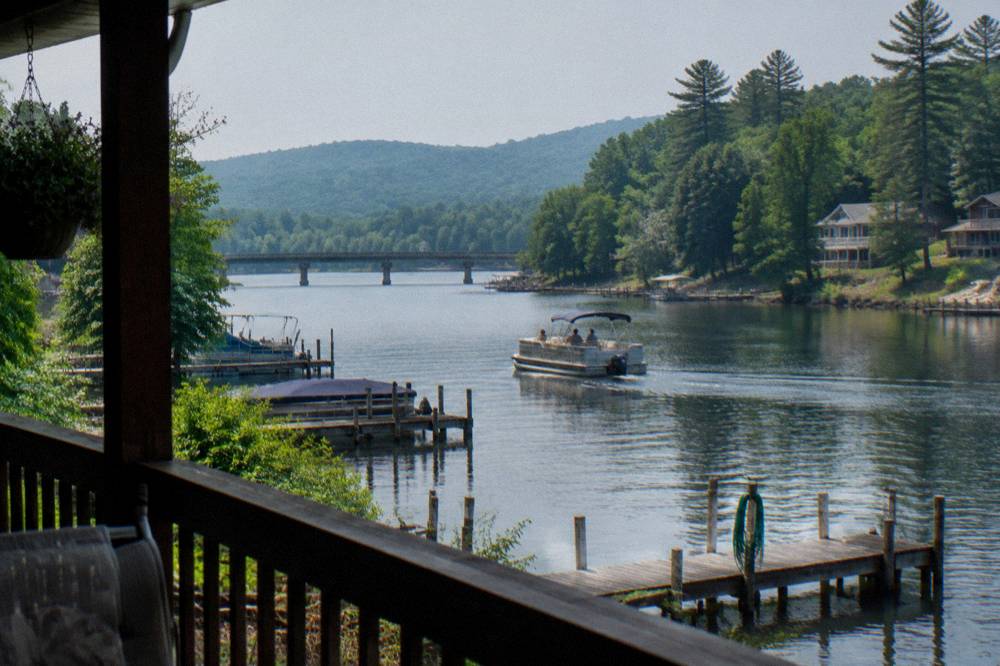
Vessels on Deep Creek Lake must operate at no-wake speed within 100 feet of the shoreline, bridges, piers, docks or other vessels, with one exception for a boat starting a tow from a pier or the shore. Because the lake has 69 miles of shoreline and long fingers of narrow cove, that single rule governs most of the water you will actually drive through. The source is the Maryland DNR lake rules page.
No-wake speed means the slowest speed at which a boat can still be steered, the point where the stern stops throwing a wave. On a lake this shape, the rule is less a restriction than the basic grammar of driving. The main basin between the Deep Creek Lake Bridge and the Glendale Bridge is wide enough for real speed; the cove tips, where kayakers gather and shoreline docks cluster, are effectively idle-only zones end to end. The Garrett County Chamber's lake geography makes the pattern explicit: kayakers favor cove tips, sailboats gather below the Glendale Bridge, and the busy rental-and-restaurant cluster sits at McHenry Cove at the northern tip.
| Rule | What it means on the water | Source |
|---|---|---|
| No-wake within 100 ft of shore, bridges, piers, docks, vessels | Idle speed along coves and dock lines; throttle only in open basins | DNR Deep Creek Lake rules |
| Posted 6-knot zones, no skiing | Marked by white signs or buoys with an orange circle | Third-party DNR rule summary |
| Night skiing illegal | No towing after dark, anywhere on the lake | DNR rule summary |
| Tow start exception | You may leave a pier or shore at speed only to get a skier up | DNR lake rules |
The tow-start exception is the detail experienced captains know and first-timers miss. Pulling a tube or a wakeboarder means getting the boat planing, and you cannot plane inside 100 feet of a dock. The exception permits the acceleration needed to get a rider up when starting from a pier or the shoreline, and only that. Once the rider is up, the normal no-wake distances apply again on the way out.
For a family renting a pontoon for a slow loop of the lake, the no-wake rule barely registers. For anyone renting a ski boat or towing tubes, it is the single rule that decides where the fun happens: you pick it up in the open water, you drop it well clear of the dock line, and you idle the last stretch home. A guided pontoon tour handles all of this for you, which is one reason the Wisp concession's State Park tours and High Mountain Sports both run relaxed, interpretive-style cruises rather than thrill rides.
Personal watercraft may not operate between 11 a.m. and 4 p.m. on Memorial Day weekend (Saturday, Sunday and the holiday) and on Saturdays, Sundays and holidays from July 1 through Labor Day. State and local government vessels are exempt. The restriction is part of the COMAR rules for this lake specifically, not a statewide Maryland law.
Those five hours are the warmest, calmest, most crowded hours of a summer weekend, and the rule removes PWCs from all of them. The intent is congestion and conflict management on a 3,900-acre lake that packs a summer's worth of boats into narrow coves. If you are planning a jet ski day in July, your window is early morning or late afternoon on the weekend, or any time Monday through Friday.
The general Maryland PWC rules stack on top of the local hours. The operator must be at least 16, must wear a U.S. Coast Guard approved life jacket, must carry a boating safety certificate if born on or after July 1, 1972, must stay at 6 knots or slower within 100 feet of another vessel, the shore, a pier, a bridge or people in the water, must use a kill switch or self-circling device, may not operate between sunset and sunrise, and must display the Maryland PWC regulation sticker. The DNR personal watercraft page carries the full list, and Funtime Watersports in Thayerville rents jet skis under these rules, with reservations recommended on its own page.
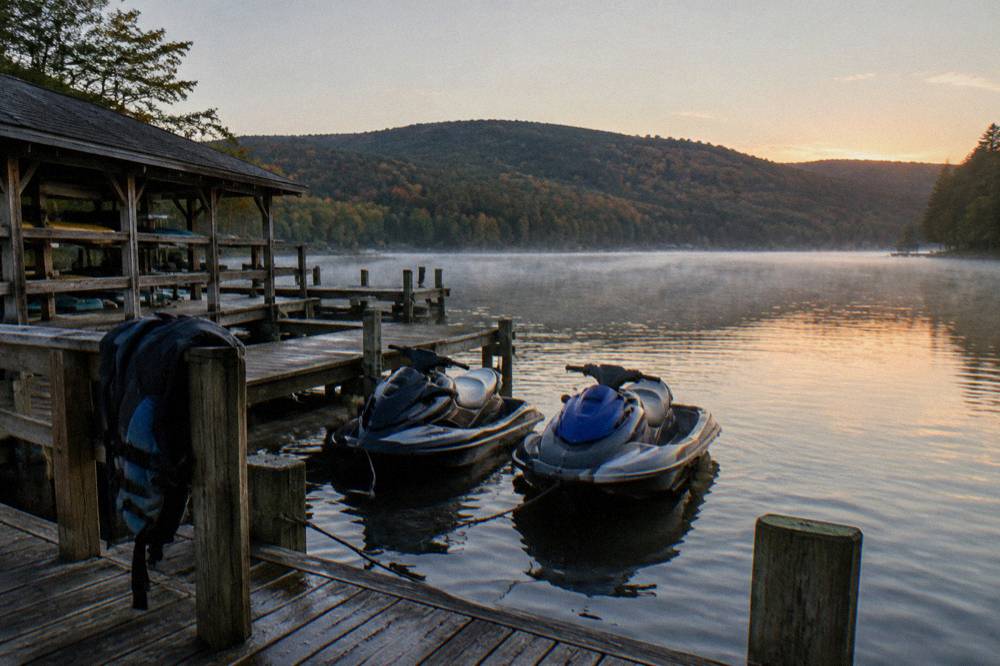
One planning note worth the detail: the quiet-hours rule is also why the lake reads calm in the middle of a summer Saturday. Pontoon tours, sailboats, kayaks and paddleboards own the midday water, and the jet ski crowd gets the lake back at 4 p.m. sharp. Photographers and swimmers who want glassy water should be out before 11.
Maryland requires anyone born on or after July 1, 1972 to carry a NASBLA-approved boating safety education certificate to operate a numbered or documented motorized vessel, including on Deep Creek Lake. Renters of motorized vessels other than personal watercraft get a simpler path: read the rental company's safety sheet and receive a 10-day temporary certificate issued on the spot. No separate Deep Creek Lake license exists.
The rental exemption is the piece most visitors need. You do not take a course to rent a pontoon for an afternoon. The rental company, whether that is Lake Life Boat Rentals in McHenry, Deep Creek Lake Boats across the road, or Bill's Marine Service, walks you through a safety sheet and issues the temporary certificate, which covers you for the rental period up to 10 days. The DNR rental requirements page states the process, and our companion explainer on pontoon rental licensing in Maryland walks through it step by step.
Private boat owners trailering their own vessel in have no exemption. If you were born after the cutoff and you are operating your own boat, you need the certificate before you launch at the State Park ramp. The DNR boating safety education page lists the approved courses, and the certificate is valid across Maryland waters, so a course taken for the Chesapeake covers you here too.
| Situation | Certificate needed | How you get it |
|---|---|---|
| Renting a pontoon or motorboat, born on or after July 1, 1972 | 10-day temporary certificate | Issued by the rental company after a safety sheet |
| Renting a personal watercraft | Full certificate required | NASBLA-approved course in advance |
| Operating your own motorized vessel, born on or after July 1, 1972 | Full certificate | NASBLA-approved course in advance |
| Born before July 1, 1972 | None | Not applicable |
Deep Creek Lake enforces an 88-decibel noise limit, tested at idle, down from the earlier 90-decibel standard, and boats may not run with open cutouts. The tighter number came from DNR enforcement of the lake's regulations and is summarized by the lake's property owners association and marina sources. In practice it targets loud exhaust systems, not normal engine noise from a stock rental boat.
Eighty-eight decibels at idle is loud up close, well above ordinary conversation, and a factory pontoon or ski boat passes without thinking about it. The boats that fail are modified exhaust systems, the cutout-equipped engines that sound great across a cove and read as a violation on a meter. If you are trailering your own boat in, and it has aftermarket exhaust, assume you are the target of this rule and check before you launch.
The noise limit connects to a broader pattern in the lake's regulations: this is a lake managed deliberately for mixed use. Bass boats, sailboats, kayaks, pontoons full of kids and lakefront houses sharing 69 miles of shoreline. The DNR boating page for the lake lists noise limits, mufflers, speed zones, coves with limited space for towing and wake surfing, a lake map and a carrying capacity study as its official topics, which tells you the state is actively managing how many boats and what kind of boats this water carries. Our overview of boating on Deep Creek Lake puts the rules in that bigger picture.
Maryland prohibits placing any vessel or equipment with attached aquatic plants, zebra mussels or other prohibited nonnative organisms into state waters, and Deep Creek Lake enforces this at the public ramp. Boats must be cleaned, drained and dried before launching, with DNR advising at least 48 hours of drying time. Penalties reach 30 days in jail, $2,500 per offense and $25,000 per enforcement action. Launch Stewards at the State Park ramp offer free voluntary inspections.
The rule exists because the lake has hydrilla, found in 2013 and under continuous herbicide treatment since, and because zebra and quagga mussels are not currently in the lake and the state intends to keep it that way. The DNR invasive species page for the lake is the authority, and it frames Clean, Drain, Dry as the visitor's part of the program.
For a renter arriving at McHenry, none of this applies; the rental fleet lives on or near the lake and the operators handle it. For anyone bringing their own boat, the routine is: pull the drain plug during transport, wash off any plant material from the hull, trailer and prop, dry wet wells and livewells, and expect a friendly steward at the ramp offering a free look-over. Voluntary means you can decline, but the underlying legal requirement to launch clean stands either way.
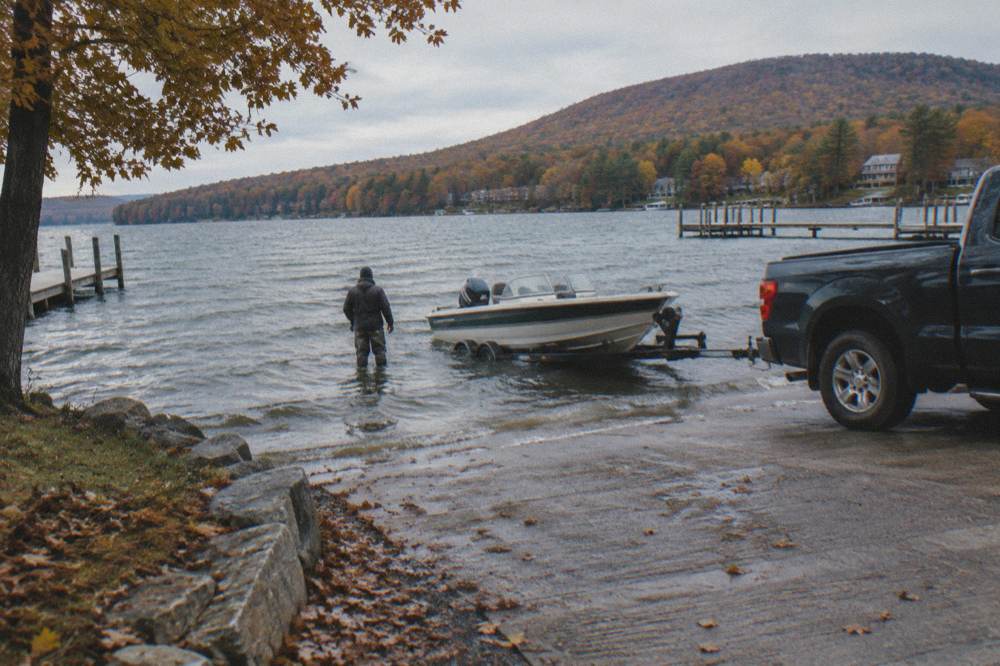
The primary public access is the State Park boat launch on State Park Road in Swanton, open 24 hours a day weather permitting, with a four-vehicle launch area and overnight slips reserved for State Park campers. A launch fee applies on every use, or you can display a valid lake use permit or Maryland State Park pass instead. Confirm the current fee on the official DNR fees page before you go.
A launch fee or a valid pass applies, and the state deliberately does not make the number easy to quote secondhand: check the DNR fees page for the current figure rather than trusting a summary, including this one. The same page covers the State Park Passport, an annual pass that covers day-use entry and, per the park page, can substitute at the ramp. In winter, the number to call for ramp conditions is 301-387-5563, or the duty ranger at 240-405-9827.
Beaching a boat is not permitted on the shoreline except in emergencies, so the ramp is not just the main access, it is functionally the only public one for trailered boats. Except for a small buoyed area at the outlet, a boat can reach the entire lake from the State Park ramp, which makes it the hinge point for the whole lake's summer traffic. Our guide to ramps and launching at Deep Creek Lake covers arrival timing and the winter gate closure in detail.
| Access point | What it offers | Notes |
|---|---|---|
| State Park boat launch | Four-vehicle launch area, 24 hours weather permitting | Fee per launch or valid pass; overnight slips for campers only |
| State Park main beach lot | Canoe and kayak launch | Paddlecraft only |
| Rental fleets (McHenry, Thayerville) | Operator-managed launches for rented boats | No personal trailer access |
Visitors launching their own boat often stay on the Oakland side of the lake for the quieter southern access. The Garrett Inn sits about 2.4 miles from the lake by car, per its own listing, close enough to make an early ramp run easy without paying waterfront rates.
Oakland
About 2.4 miles (3 minutes by car) from the lake per the listing.
Check ratesThree rules routinely catch new boaters: the 100-foot no-wake zone applies near every dock and shoreline, so most cove driving is idle-speed; jet skis vanish from the water between 11 a.m. and 4 p.m. on summer weekends and holidays; and night skiing is illegal, ending tow sports at dark. Add the 26-foot length cap and the 88-decibel limit, and the lake runs quieter and smaller than first-time visitors expect.
The no-wake surprise is the biggest. Boaters accustomed to lakes where the zone is marked with buoys arrive here and discover the zone is effectively everywhere within 100 feet of anything, which on a finger cove means the whole cove. DNR-linked summaries of the posted zones add the second layer: white signs or buoys with an orange circle mark 6-knot, no-skiing areas on top of the general rule.
The second surprise is the sanitation rule. Marine sanitation devices that can discharge into the lake are not allowed, and dumping garbage overboard is prohibited. This is a drinking-water-adjacent, hydroelectric, state-owned lake, and the rules treat it that way. Rental pontoons come with holding tanks, not through-hulls, and captains are expected to use the pumpout services rather than the water.
The third is simpler and more pleasant: the rules make the lake feel orderly. A pontoon tour with the Wisp concession or High Mountain Sports moves through this regulatory landscape without the customer ever feeling it, because the captain idles at the dock line, keeps the vessel inside the length cap and finishes before dark. Guided tours are, in a sense, the rules packaged as a product, and our pontoon boat tours overview compares what each operator runs.
The core regulations hold year round, but the lake itself does not: boat rental seasons run roughly late May to early September to mid-October, private and commercial docks must come out of the water for winter, the State Park main gate closes during snowmobile season from December 15 to March 15, and the PWC weekend blackout ends at Labor Day. Fall and winter boating means fewer services and a lake managed toward its lower rule band.
Dock rules are the seasonal hinge. The property owners association states private and commercial docks must be out of the water from November 30 until April 1, and DNR-linked park updates describe the State Park's public docks coming out in stages across late fall. By the time ice fishing season starts, typically late December into a normal winter, the summer lake is physically dismantled along its shoreline.
The rental calendar follows. Lake Life Boat Rentals runs about mid-May to mid-October; Deep Creek Lake Boats runs late May to early September; Bill's Marine closes its rental season in late September. Check each operator's own page for the exact dates in any given year, since weather moves the margins. Between seasons, the lake belongs to paddlers and anglers, and the DNR fishing page notes it becomes Maryland's premier ice-fishing destination when the weather cooperates.
Visitors planning an overnight stay around a fall boating or foliage trip have solid options on both ends of the lake. Lake Pointe Inn sits near the State Park with a free full breakfast and a golf course next door, per its listing, which pairs well with early ramp runs in the shortening autumn light. Closer to McHenry, Shamrock Inn markets itself under the Deep Creek Lake name from the Oakland side, per its listing. Our broader rundown of where to stay for boating on Deep Creek Lake maps the tradeoffs by lake area.
Maryland Natural Resources Police enforce the lake's regulations, and the penalties are real: the invasive-species launch rule alone carries up to 30 days in jail, $2,500 per offense and $25,000 per enforcement action, and boating violations carry their own fines. On the water, enforcement usually begins with a stop and a check for certificates, life jackets and equipment rather than a citation, but the legal exposure is the standard Maryland boating statute book.
The realistic version of enforcement is a patrol boat idling alongside to check that the driver holds a certificate, that enough life jackets are aboard and that the fire extinguisher is charged. Renters are covered by the temporary certificate, so the stop is usually short. The invasive-species rule is where the penalty schedule gets genuinely steep, and it is the one area where DNR has publicized the dollar figures, which tells you where the enforcement priority sits.
The smarter frame is that most rule-breaking here is accidental and easily avoided: know the no-wake distance, know the PWC hours, carry the certificate, launch a clean boat, and finish towing before dark. The state's own carrying-capacity study of the lake, listed among the DNR boating page topics, signals that the rules will tighten toward protecting the water rather than loosening toward more traffic. Readers who want the primary text can read COMAR 08.18.33.02 directly, and this guide from Deep Creek Boat Tours exists to translate that text into a day on the water.
McHenry
Lodging in McHenry, at the north end of the lake near the rental docks and the Wisp concession.
Check rates
The regulation caps vessels at 26 feet overall, with pontoons allowed up to 30 feet and certain molded-platform or nonconforming boats up to 27 feet. Engines may not exceed the manufacturer's recommended maximum horsepower or a total displacement of 550 cubic inches.
Vessels must run at no-wake speed within 100 feet of the shoreline, bridges, piers, docks or other vessels. The exception is starting a tow from a pier or the shore. In narrow coves this effectively means idle speed for the whole cove.
Personal watercraft may not operate from 11 a.m. to 4 p.m. on Memorial Day weekend (Saturday, Sunday and the holiday) and on Saturdays, Sundays and holidays from July 1 through Labor Day. Maryland also bars PWC operation between sunset and sunrise.
If you were born on or after July 1, 1972, Maryland requires a certificate to operate a motorized vessel, but renters of anything other than a personal watercraft can read the rental company's safety sheet and receive a 10-day temporary certificate on the spot instead of taking a course.
No. Night skiing is illegal on the lake, and posted zones marked by white signs or buoys with an orange circle carry a 6-knot limit with no skiing at any hour.
The limit is 88 decibels tested at idle, tightened from the earlier 90-decibel standard, and boats may not run with open cutouts. Stock rental boats pass easily; the rule targets modified exhaust systems.
Before you go, the pick for this guide:
Lake Pointe Inn
Close to the lake and the State Park, with free full breakfast and an adjacent golf course per the listing.
Check rates →