Can You Bring Your Own Boat To Deep Creek Lake?
Yes, you can bring your own boat to Deep Creek Lake. Here is how launching, size limits, safety certificates and the invasive species check work at Maryland's largest lake.
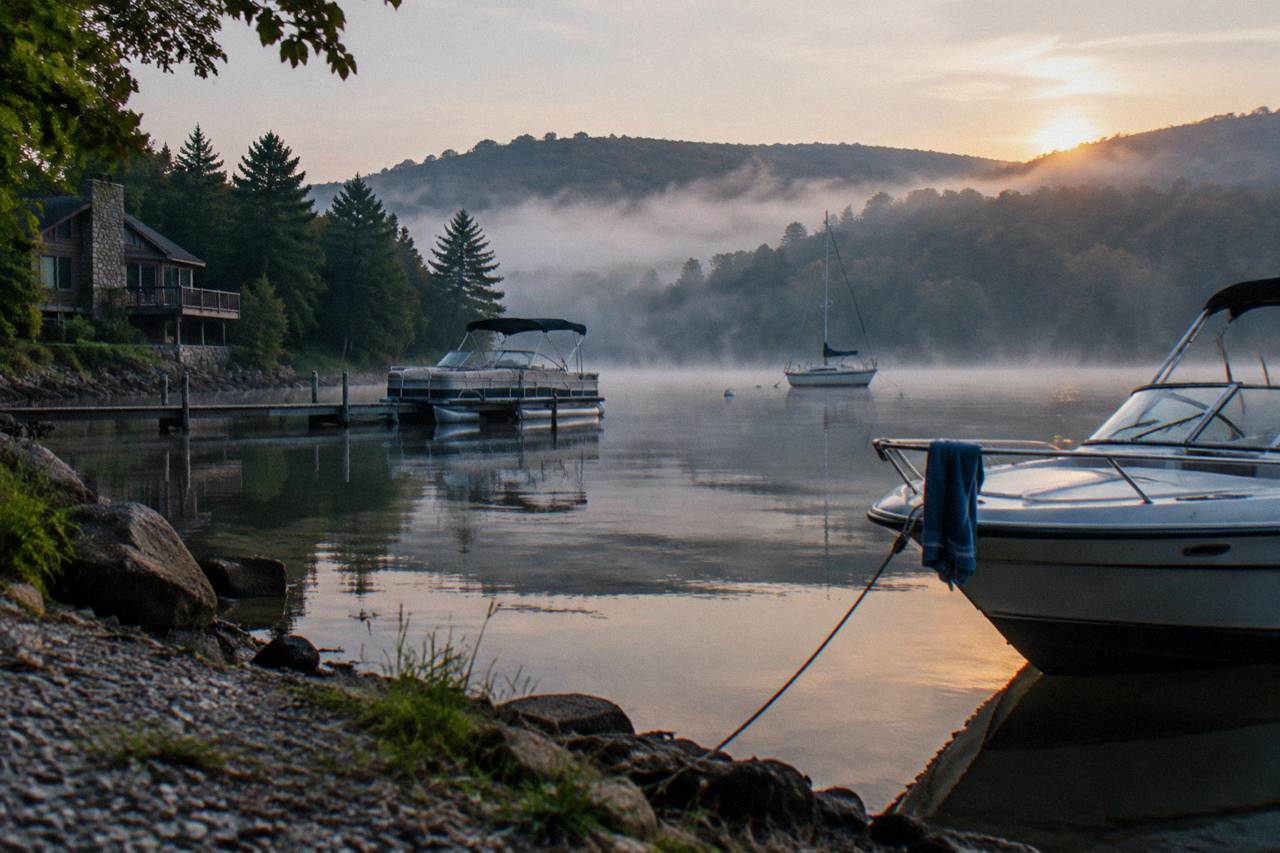
Yes, you can bring your own boat to Deep Creek Lake. The Maryland Department of Natural Resources states that except for a small buoyed area at the outlet, boats can reach the entire lake, and the primary access for private boaters is the State Park launch near Swanton. A launch fee or a valid lake use permit applies each time you put in, and the ramp is open 24 hours a day, weather permitting, which makes it one of the most accessible public ramps in western Maryland.
The lake is not a private resort puddle. It is a 3,900 acre impoundment, 13 miles long with 69 miles of shoreline, and the state owns the water, the lake bed and the buffer strip of land around it. That public ownership is the reason a trailer boater from Pennsylvania, Virginia or anywhere else can back down a ramp here and spend the day exploring coves that most lake visitors only see from a rented pontoon. Deep Creek Boat Tours covers the guided and rental side of the lake; this page is for people who already own the boat.
There are rules, and they are specific. Boats are capped at 26 feet overall, pontoons at 30. Anyone born on or after July 1, 1972 needs a boating safety certificate to drive a motorized vessel. And before the boat touches the water, Maryland's invasive species law requires it to be clean, drained and dry. None of it is onerous, but each item is enforced, and each one is worth understanding before you hitch up the trailer. The sections below walk through the launch, the limits, the paperwork, the inspection, the on-water rules, where to sleep near the ramp and what a boating weekend here actually costs. Once you know the local rules, the next question is what a day on the water actually looks like, and our guide to boating on Deep Creek Lake covers everything from launches to lodging.
Where Can You Launch Your Own Boat At Deep Creek Lake?
The main public launch is the Deep Creek Lake State Park boat ramp on State Park Road near Swanton, open 24 hours a day, weather permitting. The DNR describes it as the primary access for boaters, with a four-vehicle launch area, overnight slips reserved for State Park campers, and either a per-launch fee or a valid lake use permit required each visit.
That single-ramp setup surprises some first-time visitors. Unlike lakes with a ring of competing marinas and public ramps, Deep Creek Lake funnels most trailer traffic through one state-run facility on the eastern shore, inside the park that also holds the swim beach, the campground and the Discovery Center. The DNR's State Park page is the primary source for ramp hours, phone numbers and the camper-only slip policy, and it is worth a read before any early or late season trip, because weather and lake level both shape when the ramp is genuinely usable. In winter, the park advises calling ahead on 301-387-5563 for ramp conditions.
Overnight docking is the detail that trips people up. If you are camping in the State Park's 112-site campground, you can keep the boat in a slip overnight. If you are staying elsewhere, plan to pull the boat out each evening, which at this lake is less of a hardship than it sounds: the launch runs around the clock, and the sunset hours on the water are a large part of why people bring their own boat in the first place. For a fuller rundown of ramps, rampside logistics and launching angles, the companion guide on boat ramps and launching at Deep Creek Lake goes deeper on the practical side.
A launch fee applies, or you can display a pass. The fee schedule lives on the DNR fees page, which is the only reliable place for the current dollar amounts, so check it there rather than trusting a cached forum number: Maryland DNR fees page.
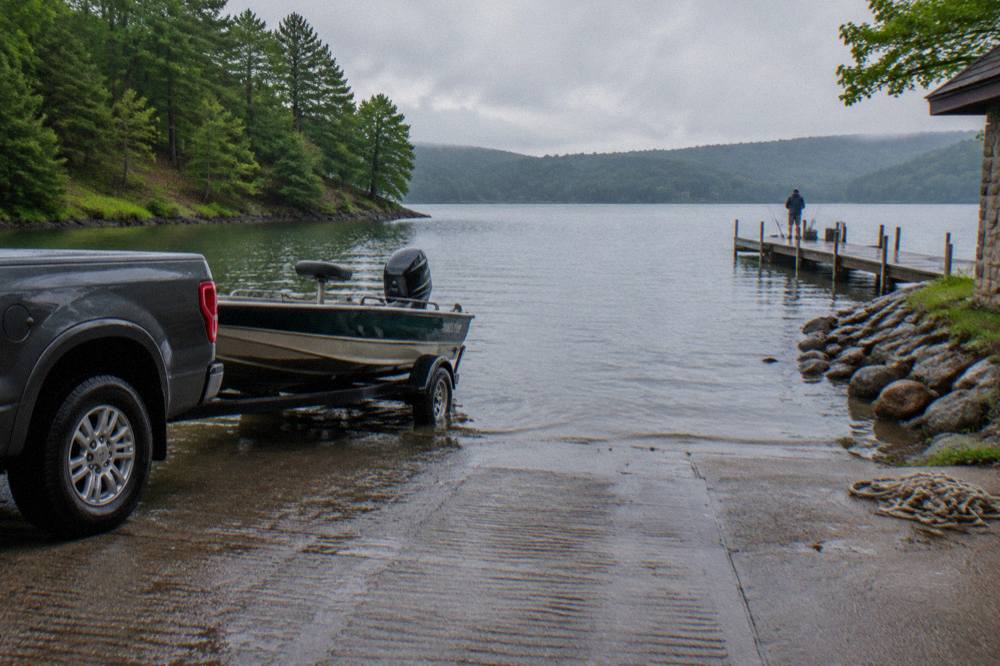
The launch experience itself is straightforward by public-ramp standards. The four-vehicle launch area means the queue moves in batches rather than one wide-load drama at a time, and summer mornings concentrate traffic in the first two hours after the gates open at 8 a.m. for day use. Boaters who arrive mid-afternoon often have the ramp nearly to themselves, and since the lake's best water for skiing and towing tends to smooth out again before dinner, a later launch trades queue time for a shorter glass-water window.
One more access note for anglers: beaching a boat is not permitted on the shoreline except in emergencies, per the DNR's fishing pages, which makes the ramp the primary public access for motorized boats launching onto the lake. Shoreline fishing is possible from public access points, but if you brought a boat, you launch it at the ramp.
What Are The Boat Size And Engine Limits On Deep Creek Lake?
Boats on Deep Creek Lake are limited to 26 feet overall, with pontoons allowed up to 30 feet, and an engine may not exceed the manufacturer's recommended maximum horsepower. DNR-linked summaries of the lake's regulations also describe a displacement cap of 550 cubic inches for engines. There is a narrow exception for certain nonconforming or molded-platform hulls, but the practical rule is simple: if your boat is longer than 26 feet, it stays home.
The size limit is the single most common deal breaker for visiting boaters, and it exists for a reason anyone who has seen the lake will understand. This is a 69 mile shoreline wrapped around deep coves and narrow fingers, with a 100 foot no-wake band hugging nearly all of it. A 26 footer fits that geography. A 32 foot cabin cruiser does not, and the regulation reflects the lake's carrying capacity rather than an arbitrary preference.
Pontoons get the extra allowance because of how they handle. A 28 or 30 foot pontoon tracks flat, sits high and displaces gently, which is why the lake's own rental fleets run pontoon hulls as their workhorses. If you own a tritoon at 29 feet, you are legal here. If you own a 27 foot deep-V bowrider, you are not, and no amount of polite argument at the ramp changes that.
| Vessel type | Overall length allowed | Key engine rule | Source basis |
|---|---|---|---|
| General powerboat | 26 feet | Not above manufacturer's max horsepower | COMAR summary, DNR-linked |
| Pontoon boat | 30 feet | Not above manufacturer's max horsepower | COMAR summary, DNR-linked |
| Nonconforming / molded platform hull | Up to 27 feet | Same engine limits | COMAR summary |
| Kayak, canoe, paddleboard | No length limit | None (unpowered) | DNR boating pages |
The engine rules matter less for most trailer boats than the length rule, because a typical 20 to 24 foot runabout is factory matched to a horsepower rating well inside the lake's limits. Where it bites is repowered older hulls and anything with a big block shoehorned past its rating plate. The displacement cap of 550 cubic inches, as summarized in DNR-linked regulation summaries, closes that loophole. If you want the full regulatory text, the state publishes it as COMAR 08.18.33.02.
Personal watercraft have their own regime entirely, including a ban on operating between 11 a.m. and 4 p.m. on Memorial Day weekend and on Saturdays, Sundays and holidays from July 1 through Labor Day, and a requirement that operators be at least 16. That is covered in detail on the jet ski pages of this site, but if you are towing both a boat and a PWC, know that the PWC is the more restricted of the two on summer weekends.
What Papers And Certificates Do You Need On The Water?
Anyone born on or after July 1, 1972 must carry a boating safety education certificate to operate a numbered or documented vessel on Maryland waters, and Deep Creek Lake is no exception. The certificate must come from a NASBLA-approved course. If you were born before that date, no certificate is required for your own boat, though a safety course is still a sound idea on a lake this busy. Beyond the certificate, a little planning goes a long way, and our guide to packing for a day out on Deep Creek Lake covers everything from safety gear to snacks.
The certificate rule is Maryland state law, and it applies to visitors as much as residents. The DNR's boating safety education pages lay out the requirement and the approved course options. Most online courses take a few hours and cost less than a tank of fuel, so if your birthday falls after the cutoff and you are planning a trip, knock it out the week before rather than discovering the gap at the ramp.
There is a second rule aimed squarely at renters rather than owners, and it explains why the lake's rental desks move so fast: a renter of a motorized vessel born on or after July 1, 1972 reads a safety sheet, and the rental company issues a 10-day temporary certificate. As a private owner you do not get that shortcut, you need the real certificate, because no rental company is standing there to hand you one.
Beyond the certificate, the ordinary Maryland paperwork applies: current registration on the boat, matching numbers and decals, and for trailered boats, whatever your home state requires to tow it. Out-of-state boats are welcome; Maryland honors valid state registrations, and the lake's proximity to Pennsylvania, West Virginia and Virginia means out-of-state plates are common at the State Park lot. The blog post on whether you need a boating license to rent a pontoon in Maryland covers the certificate question from the renting side if you want both angles.
Boats with marine sanitation devices face one lake-specific restriction worth flagging: the regulation summaries state that sanitation devices capable of discharging into the lake are not allowed, and dumping garbage is prohibited. If your boat has a holding tank with an overboard discharge option, it needs to be secured. This is a drinking-water-adjacent, hydroelectric reservoir, and the rules treat it accordingly.
What Is The Clean Drain Dry Rule Before You Launch?
Maryland law prohibits placing a vessel or equipment with attached aquatic plants, zebra mussels or other prohibited nonnative organisms into state waters, and penalties run up to $2,500 per offense and $25,000 per enforcement action. DNR advises CLEAN, DRAIN, DRY, with at least 48 hours of drying time before launch. At the State Park ramp, Launch Stewards offer free voluntary inspections.
This is the rule most out-of-town boaters know least about, and it applies at the trailer, before the hull touches water. The DNR's invasive species page for Deep Creek Lake states the prohibition and the inspection program plainly. Hydrilla was found in the lake in 2013 and has been under herbicide treatment since, and the agency tracks new infestations, including one at Arrowhead Cove that was added to the treatment program. Zebra and quagga mussels are not currently believed to be in the lake, and the entire inspection regime exists to keep it that way.
Practically, the drill takes fifteen minutes. Pull every drain plug, lower the motor to drain the cooling passages, pull bilge plugs, inspect the trailer bunks and the outdrive for plant material, and let everything dry. If your boat came off a different lake less than 48 hours earlier, the DNR wants it dried or, ideally, washed before it goes in. The stewards at the ramp are friendly and the inspection is voluntary, but an inspector who finds a strand of milfoil wrapped around your axle is doing you a favor, because the fine for launching with attached plants is real.
| Clean Drain Dry step | What to do at the ramp | Why it matters here |
|---|---|---|
| Clean | Remove all plants, mud and debris from hull, trailer, outdrive and lines | Launching attached plants carries penalties up to $2,500 per offense |
| Drain | Pull all plugs, drain bilge, live well and motor cooling water | Removes unseen organisms in standing water |
| Dry | 48 hours of drying, or wash the boat, between waterbodies | Drying kills what draining misses |
| Inspect | Accept the free voluntary check from the Launch Stewards | Catches what a self-inspection misses |
Kayakers and paddleboard owners are inside this rule too, not just powerboaters. A paddleboard that spent August in a river with hydrilla can carry a fragment the same way a pontoon can. The steward program is built around the ramp, so paddle-craft users launching from the beach lot should do their own careful check, and the kayak and paddleboard pages of this site repeat the point because it is the cheapest insurance on the lake.
The reason for all of it is visible from any dock in late summer. Hydrilla grows fast in a lake with 25 feet of average depth and warm cove tips, and once it beds in, it changes the boating: fouled props, choked coves, and a rising treatment bill. Every clean boat that launches is a small part of why the lake still skis well in August.
What No-Wake And Speed Rules Apply To Your Boat?
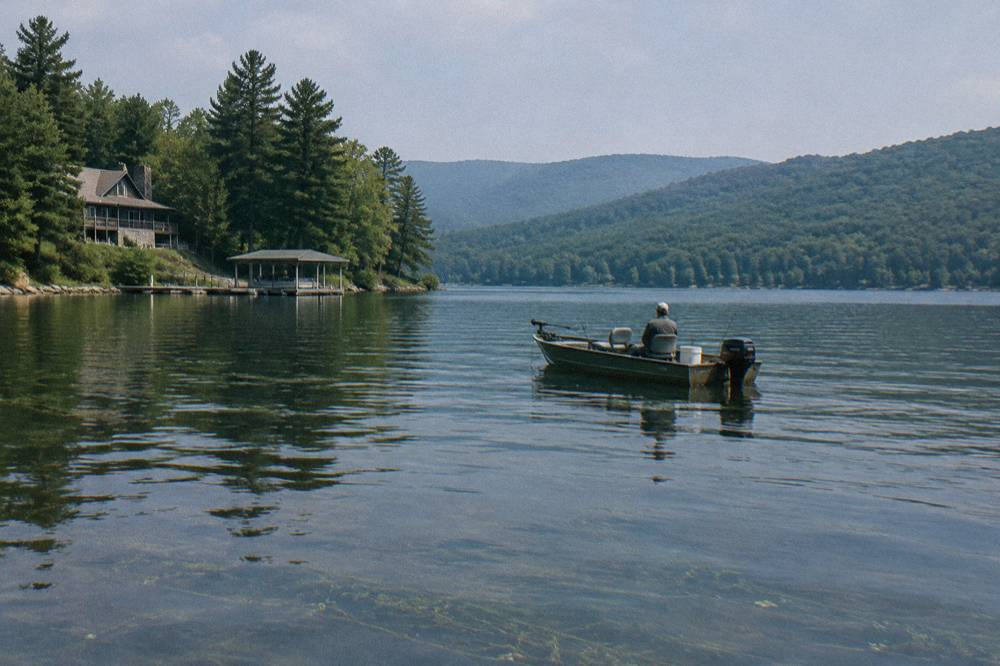
Vessels must operate at no-wake speed within 100 feet of the shoreline, bridges, piers, docks or other vessels, except when starting a tow from a pier or shore, according to the DNR's lake rules page. Posted speed areas run 6 knots with no skiing, marked by white signs or buoys with an orange circle, and night skiing is illegal. There is no general lake-wide speed limit beyond these zones.
The 100 foot no-wake rule is the one that shapes every hour you spend driving here. With 69 miles of shoreline, the band hugs a huge share of the lake's usable width, and the practical effect is that you plane out in the middle and settle down near anything fixed. Boaters used to open lakes sometimes chafe at it, but on an impoundment with this many docks, swimmers and anchored fishing boats, it is the rule that makes the shared-water arrangement work. The DNR states it on its Deep Creek Lake Natural Resource Management Area page, which also covers lake rules generally.
The lake's geography makes the rule easier to live with than it sounds. The main basin below the Deep Creek Lake Bridge is broad water where the 100 foot band is a thin ribbon at the edges, and the quiet coves below the Glendale Bridge, where sailboats congregate, are places you want to be slow anyway. The friction zones are the narrow necks and cove mouths in the north end near McHenry, where boat traffic, restaurant docks and rental fleets concentrate. The guide to boating rules on Deep Creek Lake walks the zones in more detail.
Noise is the other enforcement point. The lake association reports the standard was lowered from 90 to 88 decibels, tested at idle, and boats may not run with open cutouts. For a stock late-model boat this is invisible. For an older hull with straight pipes, it is a reason to sort the muffler before the trip, because a failed idle test at the dock ends the day before it starts.
Wake surfing deserves a note because it is the sport most affected by the distance rules, and a DNR-linked policy review discussion of wake boats maintained the status quo on distance requirements. The takeaway for a visiting surf-boater: the 100 foot rule applies to you with extra emphasis, the DNR's boating pages list coves with limited space for towing and wake surfing, and the lake map on those pages marks them. Pick your cove accordingly.
Where Can You Stay Near The Deep Creek Lake State Park Launch?
The closest lodging cluster to the State Park launch is the McHenry area at the lake's north end, where Wisp Resort sits about 0.6 miles from the water and several inns cluster near the park entrance. Deep Creek Lake State Park itself offers a 112-site campground, and overnight slips at the launch are reserved for those campers, so staying in the park is the only way to keep a boat in the water overnight.
For trailer boaters, the camping option deserves first consideration precisely because of that slip rule. Camp, and your boat stays wet; lodge anywhere else, and you trailer it both ways daily. The campground sits within the park that contains the ramp, so the commute is minutes, and the park's 20 miles of trails and two sandy beaches fill the off-water hours. Day use runs 8 a.m. to sunset, with per-person fees in the summer season and per-vehicle fees the rest of the year.
If camping is not your style, McHenry is the practical base. The listing for Lake Pointe Inn places it in McHenry near Deep Creek Lake State Park, with a free full breakfast and an adjacent golf course, which covers the early launch and the afternoon when the family is done with the boat. A hot breakfast before a 7 a.m. ramp run is not a small thing. Toward the quieter south end, the listing for The Garrett Inn puts you in Oakland about 2.4 miles from the lake, a few minutes by car, and closer to the Glendale Bridge coves if your boating skews toward fishing rather than towing.
LakeFront Lodge
McHenry
Lodging in McHenry, at the north end of the lake near the rental docks and the Wisp concession.
Check ratesThe third option in this cluster, LakeFront Lodge, is a lodging option in the McHenry area near the north end of the lake, handy if you want to be close to the launch and rental cluster without driving far. None of these are marina hotels in the big-resort sense; this lake's lodging stock is inns, lodges and condo-style suites, and the where-to-stay guide on this site sorts the whole area by boating priority.
One planning note that interacts with lodging: the State Park main gate closes during snowmobile season, from December 15 to March 15, with parking moving to the Discovery Center. For the summer boating months this is irrelevant, but anyone eyeing a late-fall fishing trip should know the gate and ramp picture changes as the docks come out in stages across late fall.
What Does A Weekend Of Boating Here Actually Cost?
A visiting boater's direct costs are the launch fee or pass each day, fuel, and lodging, since the lake itself charges nothing beyond access. Operator pricing gives a useful benchmark for what a day on the water is worth here: guided pontoon tours run from $34 for adults, and pontoon rentals from about $450 to $650 per day depending on horsepower. Check current figures on each operator's own page before budgeting.
The launch fee itself is the smallest line item, and its current amount lives on the DNR fees page linked earlier rather than in this article, because fee schedules change. What is stable is the structure: pay per launch, or hold a lake use permit or Maryland State Park pass. A multi-day trip with daily launches is when the pass math starts to matter.
The rental benchmark is worth having even if you bring your own boat, because it tells you what you are saving. Deep Creek Lake Boats lists one-day pontoon rentals at about $450 for a 70 horsepower boat, about $575 at 115 horsepower and about $650 at 150 horsepower, taxes extra. Lake Life Boat Rentals lists pontoons from about $524 per day and ski boats from about $681 per day, with full days running 9 a.m. to 5 p.m. Those are operator-listed figures, confirm them on their pages, and remember prices change.
| Cost item | Planning figure | Notes |
|---|---|---|
| Launch fee | Per launch, current amount on the DNR fees page | Or a lake use permit / State Park pass |
| Guided pontoon tour benchmark | Adult from $34 (Wisp lists on its own page) | 1 hour tour; a comparison point, not a fee you owe |
| Pontoon rental benchmark | About $450 to $650 per day plus taxes | As listed by Deep Creek Lake Boats |
| Fuel | Variable by boat and hours | Main basin running burns more than cove time |
| Lodging | Inn rates vary; campground is the budget path | Campers get the overnight slips |
Against those benchmarks, a boater who already owns a trailerable runabout is bringing a rental-grade day on the water to the lake for the cost of a launch fee and fuel. That arithmetic is the honest answer to why people tow here from three states, and why the State Park lot fills with out-of-state trailers on summer Saturdays. The full cost picture, including the tour and rental tiers, is laid out in the Deep Creek Lake boating costs guide.
Should You Bring Your Own Boat Or Rent One On The Lake?
Bring your own boat if it is 26 feet or under, you have the safety certificate if born after July 1, 1972, and you want multiple days on the water, because rental days at $450 to $650 add up fast. Rent instead if you are flying in, staying briefly, or your boat exceeds the length limit, since the lake's rental fleets are built to fit the rules exactly.
The case for towing your own boat is mostly economic and partly comfort. You know your boat, your family knows its seats and its quirks, and you are not re-learning a rental helm during the best water of the morning. For a full week, the math leans hard toward your own trailer: even at the low end of the rental range, a week of daily pontoon rental exceeds the cost of a lot of fuel and a season of launch fees. And the fishing crowd has extra reasons, since knowing your own sonar and your own trolling motor matters on a lake where walleye and smallmouth draw serious anglers.
The case for renting is flexibility. The Wisp concession that runs the State Park beach also offers kayak, paddleboard and tube rentals by the hour, with the operator listing kayak rental at $19 for one hour, and guided pontoon tours from $34 for adults, reservations required. That is a low-commitment way to get on the water for an afternoon without a tow vehicle, and the tour option puts a local guide at the wheel who knows where the coves open up. Treat those as the operator's listed prices and confirm before booking.
One hybrid worth naming: tow the boat, but leave the paddle-craft at home. Delivered rental outfits like Deep Creek Paddle Co bring kayaks and paddleboards to you, with single kayaks from $35 and standup paddleboards from $40 as listed on its own page. That spares the roof rack and still fills the calm-water hours when the boat is on the trailer.
Whichever way you go, the seasons differ. Rental outfits here run roughly late May to mid-October at the longest, and a private boat extends your window at both ends, within the limits of ramp conditions and the docks-out schedule in late fall. The trade is storage and towing; the reward is an early June weekday on a lake that summer weekends crowd. The guide to the best time for boating on Deep Creek Lake sorts the calendar in detail.
The Garrett Inn
Oakland
About 2.4 miles (3 minutes by car) from the lake per the listing.
Check ratesCommon Questions About Bringing Your Own Boat To Deep Creek Lake
Can You Bring Your Own Boat To Deep Creek Lake?
Yes. The lake is state owned and open to private boats, with the State Park launch near Swanton as the primary public access, open 24 hours a day weather permitting. A launch fee or a valid lake use permit or State Park pass applies each launch.
Is there a boat length limit at Deep Creek Lake?
Yes. Boats are limited to 26 feet overall, with pontoons allowed up to 30 feet and a narrow exception for certain nonconforming hulls up to 27 feet. Engines may not exceed the manufacturer's recommended maximum horsepower.
Do I need a boating certificate to drive my own boat on the lake?
If you were born on or after July 1, 1972, yes, Maryland requires a NASBLA-approved boating safety education certificate to operate a numbered or documented motorized vessel. Born before that date, no certificate is required.
Can my boat stay in the water overnight?
Only if you are camping at Deep Creek Lake State Park. Overnight slips at the launch are reserved for State Park campers; everyone else trailers out each evening, which the 24-hour ramp makes easy.
What is the Clean Drain Dry requirement?
State law prohibits launching a vessel with attached aquatic plants or prohibited nonnative organisms, with penalties up to $2,500 per offense. Clean, drain and dry your boat, ideally with 48 hours of drying between waterbodies, and accept the free voluntary inspection from the Launch Stewards at the ramp.
When do the docks come out at Deep Creek Lake?
Docks come out in stages across late fall. The lake association reports private and commercial docks must be out of the water from November 30 until April 1, and the State Park main gate closes for snowmobile season from December 15 to March 15.