Do I Need A Permit To Kayak In Maryland?
No, Maryland does not require a permit to kayak on non-motorized paddle craft, including Deep Creek Lake. Here is what does apply: launch fees, safety certificate rules, PFD requirements and invasive species checks.
No, Maryland requires no permit, license or registration to paddle a kayak that has no motor, and that holds true on every body of water in the state including Deep Creek Lake. The Maryland Department of Natural Resources regulates the operator, not the paddle craft: what actually applies is a launch fee or lake use permit when you use the State Park boat ramp, a boating safety education certificate if you are born on or after July 1, 1972 and operating a motorized vessel, a wearable life jacket for every paddler, and the state's Clean Drain Dry invasive species rules before your hull touches the water. None of that is a kayak permit. It is a short list of separate requirements that trip up paddlers who heard the word permit somewhere and assumed it applied to them. If you're bringing a bigger vessel along on the same trip, the guide to bringing your own boat to Deep Creek Lake explains how launching, size limits and the invasive species check work for motorized craft.
The confusion is understandable. Maryland's boating pages mention permits constantly: lake use permits, commercial use permits, launch permits, day use fees. Almost none of it touches a person carrying a plastic kayak down to a public shoreline. This article separates the rules that apply to a paddler from the rules that apply to powerboats, personal watercraft and commercial operators, with Deep Creek Lake as the working example, because the lake is Maryland's largest impoundment at 3,900 acres and it draws kayakers from across the mid-Atlantic. The lake allows non-motorized paddling everywhere a boat can legally go, which is almost the entire lake.
No, you do not need a permit to kayak in Maryland. As long as your kayak is non-motorized, the state requires no permit, no license, no registration, and no certificate of any kind, and this holds true on any water in the state. The Maryland Department of Natural Resources requires a boating safety education certificate only for operators of numbered or documented motorized vessels born on or after July 1, 1972, and registration applies to vessels with propulsion machinery. A paddle, by itself, triggers neither. The things a Maryland kayaker does pay attention to are the launch fee or lake use permit at developed ramps such as the Deep Creek Lake State Park boat launch, a properly fitted wearable life jacket, and the invasive species inspection rules that apply to every vessel including kayaks at public ramps. Since Deep Creek Lake is one of the most popular places to paddle in the state, our guide to kayaking Deep Creek Lake covers the launch points, rental costs, and rules that apply once you get on the water.
That distinction, operator versus vessel, is the cleanest way to hold the rules in your head. The state certifies people who drive motors. It does not certify people who swing a paddle. A tandem kayak, a fishing kayak, a sea kayak and an inflatable kayak all sit on the same side of the line until someone bolts a trolling motor to the transom. The moment a motor goes on, the vessel becomes numbered equipment and the certificate requirement, plus registration, enters the picture.
The rules are set out by the Maryland DNR on its boating safety pages, and the Deep Creek Lake Natural Resources Management Area regulations layer a few lake specific rules on top. None of those layered rules is a permit requirement for paddlers either. They cover things like boat length limits, no-wake zones and where you may beach a boat, which is not permitted at Deep Creek Lake except in emergencies. A kayaker who reads a summary of Deep Creek Lake rules and sees the word permit seventeen times can be forgiven for worrying, but nearly every use of that word on those pages refers to something else: lake use permits for boats, commercial use permits for businesses on the buffer strip, and park passes for day use. If you're curious how motorized craft fit into those same lake rules, our guide to jet ski rules at Deep Creek Lake covers the time limits and age minimums riders face.
What Counts As A Permit And What Does Not?
A permit is an authorization you must obtain before doing something; Maryland kayaking requires none for the paddling itself, but three documents get mistaken for one: the State Park launch fee receipt, the lake use permit, and the boating safety certificate. The launch fee is a payment per use of the Deep Creek Lake State Park ramp, not permission to kayak. The lake use permit and the Maryland State Park pass are alternatives to paying per launch. The boating safety certificate applies to motorized vessel operators, not paddlers. Knowing which document answers which question keeps you from paying for something you do not need or skipping something you do.
| Document | Who it applies to | Applies to a plain kayak? | Where it comes up at Deep Creek Lake |
|---|---|---|---|
| Launch fee | Anyone using the State Park boat launch | Yes, if you launch from the ramp | State Park launch, open 24 hours weather permitting |
| Lake use permit | Boat owners who launch often | Optional alternative to per launch fees | Displayed in lieu of paying each use |
| Maryland State Park pass | Frequent park visitors | Optional, covers launch and day use | Accepted at the State Park gate and ramp |
| Boating safety certificate | Operators of motorized vessels born on or after July 1, 1972 | No, unless the kayak has a motor | Applies to rental pontoons and powerboats |
| Registration | Vessels with propulsion machinery | No, unless motorized | Applies to powerboats and jet skis |
| Commercial use permit | Businesses operating on the buffer strip | No | Covers marinas and tour operators, not visitors |
The fee structure at the State Park is the one place money changes hands for most visiting kayakers. The launch fee amounts and the State Park Passport prices are listed on the Maryland DNR fees page; check the DNR fees page before you go. What does not change is the principle: pay per use at the ramp, or carry a pass, or launch somewhere that does not charge. At Deep Creek Lake, the State Park ramp on the east side of the lake is the primary public launch, and the canoe and kayak launch at the main beach lot gives paddlers a dedicated, softer entry point inside the park.
There is a second layer people sometimes call a permit: day use admission to Deep Creek Lake State Park itself. That is an entrance fee for the park, charged per person in summer and per vehicle the rest of the year, and it is separate from the boat launch fee. If you drive into the park to use the beach lot kayak launch, the day use fee applies. If you launch from another public access point around the lake, it does not. Neither is a kayak permit in any legal sense.
Where Can You Legally Launch A Kayak At Deep Creek Lake?
The primary public launch is the Deep Creek Lake State Park boat ramp, open 24 hours a day weather permitting, with a dedicated canoe and kayak launch at the main beach lot inside the park; paddlers can also use public access points around the shoreline, while beaching a boat is not permitted anywhere except in emergencies. The Maryland DNR notes that except for a small buoyed area at the outlet, boats can reach the entire lake, and that holds for kayaks. No part of Deep Creek Lake is closed to non-motorized paddling, and the quiet coves below the Glendale Bridge are the sections kayakers favor most, along with the tips of coves where motorboats rarely venture.
The launch question and the permit question are related only at the ramp. If you launch from the State Park ramp, a launch fee or a valid lake use permit or State Park pass applies, as it does to every vessel using that ramp, kayak or yacht. If you launch from shoreline public access points, as anglers do, no ramp fee applies because no ramp is involved. The choice between them is usually about convenience and parking, not legality. The four vehicle launch area at the State Park fills on summer weekends, and the beach lot kayak launch spreads paddlers out.
Rental options change the launch math but not the permit answer. Deep Creek Paddle Co delivers kayaks, paddleboards and fishing kayaks to customers around the lake, with the operator listing single kayaks from $35, standup paddleboards from $40, fishing kayaks from $40 and tandems from $55 on its own page, prices subject to change. Wisp Resort Lake Adventures, the State Park boating concession, rents kayaks at $19 for one hour or $34 for two hours per its own listing, with paddleboards at $24 and $39, and reservations are required. Neither rental carries a permit requirement for the paddler. You are renting equipment, not licensing an activity.
Do You Need A Boating License To Kayak With A Motor?
Yes, you do. In Maryland, the moment your kayak carries any motor it becomes a motorized vessel, which means the kayak must be registered, and anyone born on or after July 1, 1972 must hold a NASBLA approved boating safety education certificate before operating it. That single change, a trolling motor on a fishing kayak, moves you across every line this article has drawn. The certificate rule is stated plainly by Maryland DNR and applies statewide. Renters get a narrower break: someone renting a motorized vessel, other than a personal watercraft, reads a safety sheet and receives a temporary certificate from the rental company, though at Deep Creek Lake the motorized rental fleet is mostly pontoons rather than kayaks.
Fishing kayaks blur this line in practice, because many anglers own motorized models. A pedal kayak, which uses leg drive rather than a motor, stays a non-motorized vessel and needs nothing. An electric motor kayak does not. The distinction is mechanical, not subjective: propulsion machinery means registration. If you are trailering your own motorized kayak to Deep Creek Lake, sort the registration and certificate before the trip, and carry the certificate on the water as the law expects. The DNR boating safety certificate page explains the requirement and the approved courses.
Deep Creek Lake adds its own engine rules that matter to anyone motorized: an engine may not exceed the manufacturer's recommended maximum horsepower, and boat length is capped at 26 feet overall, 30 feet for pontoons. None of that applies to a paddle only kayak, which is one of the reasons kayaking at Deep Creek Lake is the cheapest legal way onto the water. The lake's rules also restrict personal watercraft from operating between 11 a.m. and 4 p.m. on peak summer days, a rule that shrinks the afternoon chop for paddlers in coves, an underrated side effect worth knowing when you plan a midsummer route.
What Safety Rules Apply To Kayakers Without A Permit?
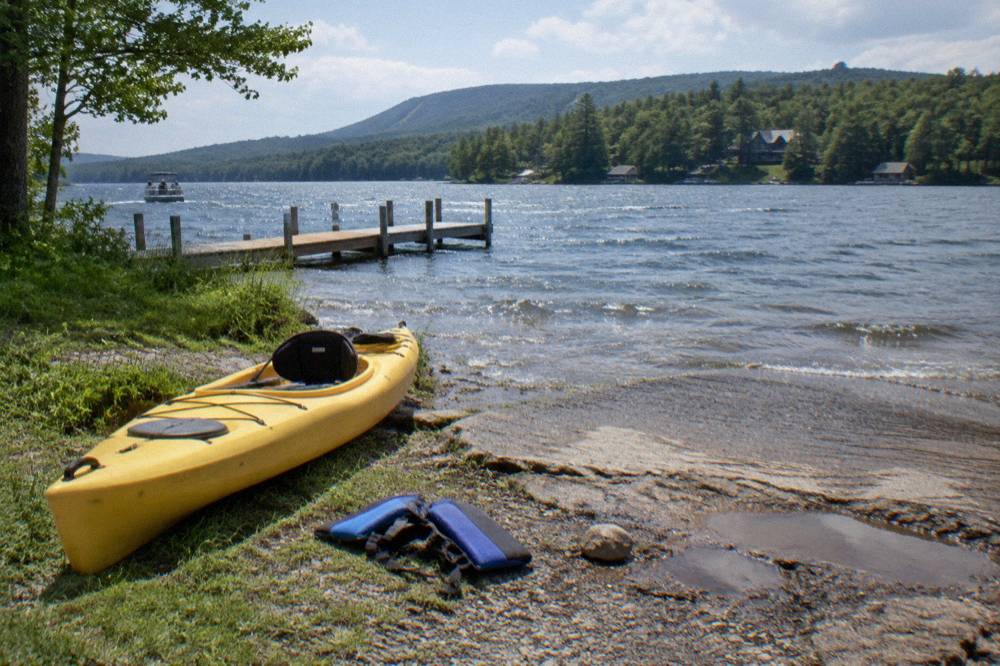
Every kayaker in Maryland must carry a wearable United States Coast Guard approved life jacket, children's rules are stricter, and Deep Creek Lake adds posted no-wake zones, night lighting rules and invasive species checks that apply to kayaks exactly as they apply to cabin cruisers. The life jacket rule is the one that actually gets enforced on paddlers, and DNR's own safety materials lean on it hardest: a paddle craft is small, the water is cold for much of the year, and Deep Creek Lake reaches about 75 feet deep near the dam with an average around 25 feet, cold water that does not warm fast even in July.
The specific equipment list for a paddle craft is short. A wearable life jacket of the right size for each person, a sound producing device such as a whistle, and a white light if you paddle after dark. Maryland's general vessel rules carry all of that. What kayakers at Deep Creek Lake should also internalize is the 100 foot rule: vessels must operate at no-wake speed within 100 feet of the shoreline, bridges, piers, docks or other vessels, per the Deep Creek Lake NRMA rules. A kayak is a vessel under that rule, and a paddler crossing a boating lane should expect powerboats to give way but should also stay visible, bright colors matter.
The invasive species rules deserve special attention because they are the closest thing to a mandatory checkpoint a kayaker encounters at Deep Creek Lake. Maryland law prohibits placing a vessel or equipment with attached aquatic plants, zebra mussels or other prohibited nonnative organisms into state waters, with penalties up to $2,500 per offense, and DNR runs free voluntary inspections through Launch Stewards at the State Park ramp. Hydrilla was found in the lake and is under a multi-year herbicide treatment program, including a newer infestation at Arrowhead Cove. CLEAN, DRAIN, DRY with at least 48 hours of drying between water bodies is the standard DNR advice, and the DNR invasive species page for Deep Creek Lake carries the details. This applies to your own kayak hauled in from another lake, which is exactly the scenario the rule was written for.
Is Deep Creek Lake Good For Beginner Kayakers?
Yes, Deep Creek Lake is a strong beginner kayaking lake because its geography supplies naturally sheltered water: the northern tip at McHenry Cove, the coves below the Glendale Bridge and the cove tips kayakers favor sit behind land that flattens the worst chop, while the main basin holds the motorboat traffic. The Garrett County Chamber's own geography summary splits the lake exactly this way, the busy north end near Wisp Resort and Garrett College, the main basin south of the Deep Creek Lake Bridge by the State Park, and the quieter southern coves below the Glendale Bridge where sailboats and paddlers concentrate. A first timer who launches at the State Park beach lot and turns south has an easy first hour.
Timing does most of the work for a nervous beginner. Mornings on the lake are calm, afternoons carry recreational boat wakes, and the personal watercraft afternoon restriction on peak summer weekends, no operation between 11 a.m. and 4 p.m., removes the most erratic traffic from the busiest hours. Weekday mornings in June or September are close to ideal: warm water, light wind, and rental counters that are not busy. The kayak and paddleboard guide for Deep Creek Lake covers routes and rental options in more depth, and the best time for boating guide breaks down the seasonal patterns.
The lake's size is also a safety asset. With 69 miles of shoreline, a tired paddler is almost never far from a cove where they can rest, and the state owns the lake bed plus the buffer strip of land around it, which keeps substantial shoreline public rather than fenced off. The rules support beginners too: the 100 foot no-wake buffer along the shoreline means motorboats passing close to shore must slow down, which is precisely where beginners paddle. The main genuine hazards are cold water early and late in the season, afternoon wind funneling down the main basin, and distance, the lake is 13 miles long and a south wind can make the return leg much harder than the outbound one.
| Deep Creek Lake section | Water character | Who it suits |
|---|---|---|
| McHenry Cove, north tip | Rentals and restaurants nearby, moderate traffic | Short outings, first time paddlers with a group |
| Main basin by the State Park | Open water, most boat traffic, deepest basin | Confident paddlers crossing to quiet shoreline |
| Coves south of the Deep Creek Lake Bridge | Mixed traffic, no-wake near shore | Intermediate paddlers building distance |
| Below the Glendale Bridge | Quietest water, sailboats and paddlers | Beginners, wildlife watchers, fishing kayaks |
| Cove tips throughout the lake | Shallow, calm, rarely visited by powerboats | Wildlife viewing, relaxed floats |
How Much Does Kayaking At Deep Creek Lake Cost?
Paddling your own kayak at Deep Creek Lake costs nothing beyond the launch fee at the State Park ramp or a pass that covers it; renting one runs from about $19 per hour at the State Park concession to delivered daily rentals from $35, with every price set by the operator and subject to change. There is no permit fee, no paddle craft license and no lake access charge for kayaks launched from public shoreline. The DNR fees page lists the current launch fee, lake use permit and State Park Passport prices, and visitors should confirm there rather than rely on any third-party number, including numbers printed in older articles.
The rental spread at Deep Creek Lake covers three models: on-site hourly rental at the State Park beach through the Wisp concession, retail rental from full service outfitters, and delivery to your lodging. Wisp Resort Lake Adventures lists kayaks at $19 for one hour or $34 for two hours, plus tubes at $9 for the day, with reservations required. Deep Creek Paddle Co lists single kayaks from $35, paddleboards from $40, fishing kayaks from $40 and tandems from $55, delivered, booked online. Those are operator listed prices with no promise attached; check each operator's page for this year's rates before budgeting. The boating costs guide for Deep Creek Lake compares the full pricing picture across pontoons, jet skis and paddle craft.
Free options exist too, and the free things to do guide collects them. Launching from public shoreline access points costs nothing. The lake itself, owned by the state, charges no paddle access fee. The only real gatekeeper is parking and the State Park day use fee if you enter the park, which runs per person in summer and per vehicle in the off season. A paddler with their own boat, a roof rack and a free access point can spend a full day on 3,900 acres of water for the price of gas to get there.
Where Should You Stay For A Kayaking Trip To Deep Creek Lake?
Most paddlers base themselves in McHenry near the State Park and the north end launches, or in Oakland on the quieter southern side close to the Thayerville stretch of shoreline; both put you within a few minutes of the water without paying lakefront rates. The Oakland side pairs particularly well with kayaking because the southern coves below the Glendale Bridge are the sections paddlers travel for, and an Oakland base puts them at the start of your route rather than across the lake from it. On the McHenry side, staying near the State Park shortens the morning drive to the beach lot kayak launch on the days you want the easiest entry.
On the Oakland side, The Garrett Inn sits about 2.4 miles from the lake, roughly three minutes by car, close enough to load a rental kayak in the morning and still be on the water before the wind picks up. Also in the Oakland area, Shamrock Inn is marketed under the Deep Creek Lake name and keeps you near the southern access points and the Thayerville shoreline. Neither is on the water, which is the trade that buys you proximity to the coves without lakefront pricing.
Shamrock Inn (In The Heart Of Deep Creek Lake)
Oakland
Oakland inn listed under the Deep Creek Lake name.
Check ratesFor paddlers who want the State Park side instead, the McHenry area is the better base. Lake Pointe Inn sits near the lake and the State Park, with a free full breakfast and an adjacent golf course, which makes the early launch routine simple: eat, drive five minutes, unload at the beach lot. The wider lodging picture, including the resort options at the north end of the lake, is laid out in the where to stay for boating guide, which matches each area of the lake to the kind of boating you plan to do.
One practical note for renters: delivery services change where you stay. If your rental kayak comes to you, the delivery radius matters more than walking distance to a ramp, and condo style lodging with parking for unloading beats a tight lakefront lot. Booking lodging with a delivery rental in mind is the pattern that works best on the southern coves, where public access points are smaller and a delivered boat beats a roof rack on a gravel pull off every time.
Do The Rules Change For Paddleboards And Canoes?
No, the rules do not change for standup paddleboards and canoes in Maryland. They follow the same requirements as kayaks: no permit, no registration, and no certificate are required, each person must carry a Coast Guard approved life jacket, and boaters must meet the same invasive species cleaning obligations at public ramps. The law draws its line at propulsion machinery, not at hull shape or paddle type. A canoe, a kayak, a paddleboard and a pedal kayak are all non-motorized vessels. A trolling motor on any of them changes the classification instantly, and personal watercraft are a stricter category entirely, with operator age minimums, night bans and their own sticker requirement in Maryland.
Paddleboards carry one nuance worth a sentence: Maryland treats a paddleboard as a vessel when it is on the water, so the life jacket requirement applies, though DNR practice recognizes the inherent flotation of a purpose built board. The sensible reading for Deep Creek Lake, where cold deep water is the norm, is to wear the jacket, not argue about it. The rental desks at the lake, Wisp Resort Lake Adventures and Deep Creek Paddle Co among them, rent both craft and will hand you the right equipment with the booking. Reservations are required at the Wisp concession and recommended elsewhere in the summer season.
Canoes open one more door at Deep Creek Lake: the State Park campground. The park holds 112 campsites and sits beside the beach lot with its canoe and kayak launch, so a canoe camping trip means waking up a short walk from the water with no launch fee logistics to solve, only the day use and camping arrangements you have already made. Paddling from camp in the early morning, before the main basin wakes up, is one of the quietest experiences the lake offers, and it requires nothing but the gear you brought.
What Should You Check Before Your First Paddle?
Confirm three things before your first Deep Creek Lake paddle: the current launch fee on the DNR fees page, whether your route crosses any posted no-wake or speed zones, and that your hull is clean, drained and dry if it has touched another lake. None of these is a permit, but each one is the kind of thing that turns a good morning into an unpleasant conversation at the ramp. The State Park launch is open 24 hours weather permitting, and the park number, 301-387-5563, is the direct line for conditions, especially outside the summer season when the main gate closes for snowmobile season and parking moves to the Discovery Center.
Weather awareness matters more at Deep Creek Lake than at smaller Maryland ponds because of the lake's shape: 13 miles long, oriented so that prevailing winds build fetch down the main basin, and cold water at depth even in August. Check the forecast for wind, not just rain. A ten mile per hour breeze down the basin produces a worked up surface in the middle sections that a beginner should not be crossing in a recreational kayak. The coves stay paddleable on days the main basin does not, which is the practical reason experienced locals head for the water below the Glendale Bridge when the forecast is marginal.
Lake Pointe Inn
McHenry, near Deep Creek Lake State Park
Close to the lake and the State Park, with free full breakfast and an adjacent golf course per the listing.
Check ratesFinally, plan your exit as carefully as your entry. Afternoon at the State Park ramp mixes kayaks, pontoon trailers and fishing boats at a four vehicle launch area, and patience is part of the drill on Saturdays. Paddlers who launch early and land before the midday rush skip most of it. That single scheduling habit, morning on the water, early afternoon off it, aligns with the calmest water, the softest light for photography, and the least crowded ramp, and it costs nothing, which fits the theme of this whole article: the best things about kayaking in Maryland, and at Deep Creek Lake in particular, start the moment you realize none of it required a permit in the first place. This site, Deep Creek Boat Tours, covers the lake's boating rules, launches and rental options in depth across its guides if you want the fuller picture.
Common Questions About Kayak Permits In Maryland
Do I Need A Permit To Kayak In Maryland?
No. Maryland requires no permit, license or registration for a non-motorized kayak on any water in the state, including Deep Creek Lake. The requirements that do apply are a launch fee or pass when using the State Park boat ramp, a wearable Coast Guard approved life jacket, and Clean Drain Dry invasive species rules before launching.
Do You Need A License To Kayak With A Trolling Motor In Maryland?
Yes. Adding any motor makes the kayak a motorized vessel, which requires registration, and the operator must hold a NASBLA approved boating safety education certificate if born on or after July 1, 1972. Remove the motor and the requirements disappear.
Do Children Need A Life Jacket To Kayak In Maryland?
Yes. Maryland requires a wearable United States Coast Guard approved life jacket for every person on a paddle craft, and the rules are stricter for children. Fit matters, a child's jacket must be the right size, and at Deep Creek Lake the cold, deep water makes wearing it, not just carrying it, the safe practice.
Do You Have To Pay To Launch A Kayak At Deep Creek Lake State Park?
Yes, a launch fee applies each time you use the State Park boat ramp, or you can display a valid lake use permit or Maryland State Park pass instead. The current amounts are on the DNR fees page, and launching from other public shoreline access points around the lake carries no ramp fee.
Can You Kayak Anywhere On Deep Creek Lake?
Almost. Except for a small buoyed area at the outlet, boats can reach the entire lake, and that includes kayaks. The rules that apply everywhere are the 100 foot no-wake zone along the shoreline, no beaching your boat except in emergencies, and areas closed to fishing such as the ranger docks and swim area at the State Park.
Is A Kayak Rental Cheaper Than Bringing Your Own Boat?
It depends on distance. Rentals at Deep Creek Lake start around $19 per hour at the State Park concession, with delivered daily rentals from $35 per the operator's own listing, while bringing your own kayak costs only the launch fee. Travelers driving more than a few hours usually find rental simpler than hauling a boat.