LakeFront Lodge
McHenry
Lodging in McHenry, at the north end of the lake near the rental docks and the Wisp concession.
Check ratesPersonal watercraft are legal on Deep Creek Lake, but they carry the tightest rule set of any vessel on the water: a 16 minimum age, a certificate requirement, and a ban on midday operation on summer weekends and holidays.
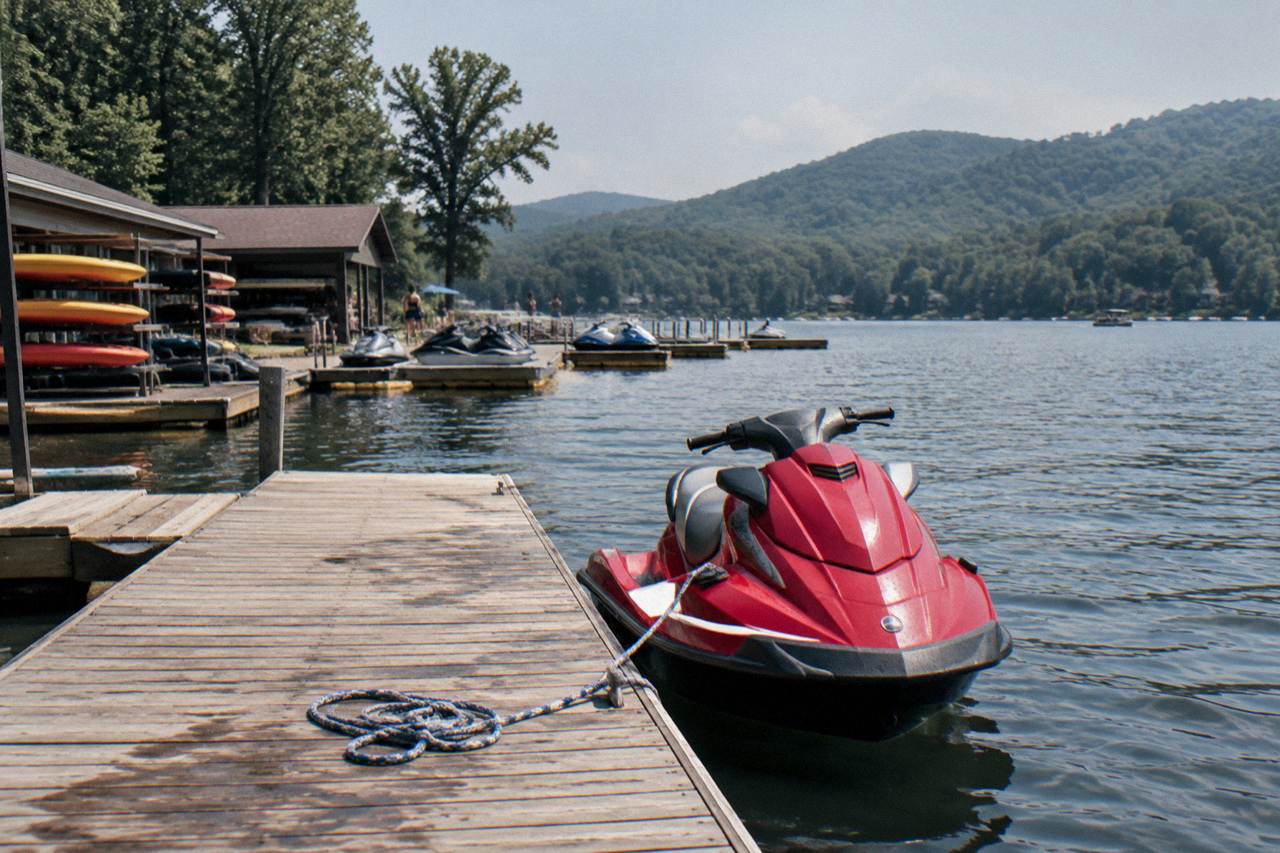
Short answer
Maryland requires a PWC operator to be at least 16, to wear a Coast Guard approved life jacket, and to hold a boating safety certificate if born on or after July 1, 1972. On Deep Creek Lake, PWC may not run between 11 a.m. and 4 p.m. on Memorial Day weekend and on Saturdays, Sundays and holidays from July 1 to Labor Day.
Deep Creek Lake allows personal watercraft, and it regulates them harder than anything else on the water. The lake is Maryland's largest impoundment at 3,900 acres, 13 miles long with 69 miles of shoreline, and the state treats PWC as the one vessel class whose hours, age floor and equipment rules are all spelled out in detail. Rent one without knowing those rules and the morning can end in a citation rather than a ride. This guide lays out the age minimum, the certificate question for renters, the quiet-hours ban that reshapes summer weekends, the no-wake zones that decide where you can actually open the throttle, and which rental operations on the lake put a jet ski on the water.
Maryland sets the minimum age to operate a personal watercraft at 16, with no exceptions for supervision or accompaniment, and the rule applies to rentals the same as owned machines. A rider younger than 16 cannot legally drive a PWC on Deep Creek Lake even with a parent aboard, even in a cove, and even on private equipment. Passengers under 16 may ride behind an adult operator where the machine is rated for two.
That age floor comes from the state's PWC regulations rather than from any local lake ordinance, so it matches what a renter would face on any Maryland waterway. The Maryland PWC requirements page lists the operator age alongside the equipment and hour rules, and it is the page a rental desk will point to when a family asks whether a 14-year-old can take the machine out alone.
The practical consequence for a rental group is planning around who actually drives. A household with teenagers can still build a day around the water: the teens can ride as passengers, operate a kayak or paddleboard freely, and take the wheel of a rented pontoon once the adult holding the required certificate is aboard and the rental paperwork is done. What they cannot do is solo a jet ski. Families booking a weekend around this should read the stay options in where to stay for boating on Deep Creek Lake alongside the rental listings, since driving distance to the dock matters more than room count when the ride windows are short.
Rental operations will ask for the operator's age and identification at check-in, and the reputable desks explain the rule before taking payment. If a listing implies that younger riders can operate under supervision, treat that as a red flag rather than a loophole.
Anyone born on or after July 1, 1972 must carry a boating safety education certificate to operate a numbered or documented vessel on Maryland waters, and a PWC rental is no exception. For most renters the practical route is the temporary certificate: read the safety sheet at the rental desk and the company issues a certificate valid for the rental period. A PWC operator must also hold the certificate, not merely ride along with someone who has one.
The certificate rule is statewide, and Maryland describes it plainly on its boating safety education page. The course behind a permanent certificate is NASBLA-approved and available online; most people finish it in a few hours. If you rent motorized vessels more than once a summer, the permanent certificate costs less hassle than repeating the temporary paperwork.
For a PWC specifically, the temporary-certificate path that covers pontoon renters is thinner. The state requirements for rented vessels describe the safety-sheet process for motorized rentals, but a PWC operator still needs to satisfy the certificate requirement in the state's own terms, and the rental desk will confirm what it accepts. Call ahead rather than assuming.
| Requirement | Who It Applies To | How A Renter Meets It |
|---|---|---|
| Boating safety certificate | Operators born on or after July 1, 1972 | Online NASBLA course, or the desk process for the rental period |
| Minimum age 16 | Every PWC operator | Identification at check-in |
| Life jacket | Operator and passengers, worn | Supplied with the rental; confirm sizing |
| Kill switch or self-circling device | The machine itself | Installed; operator clips the lanyard |
| Maryland PWC regulation sticker | The machine | Applied by the rental company |
One more detail that trips people up: the certificate requirement attaches to the person, not to ownership. Borrowing a friend's jet ski does not bypass it, and neither does renting from the most casual dock on the lake.
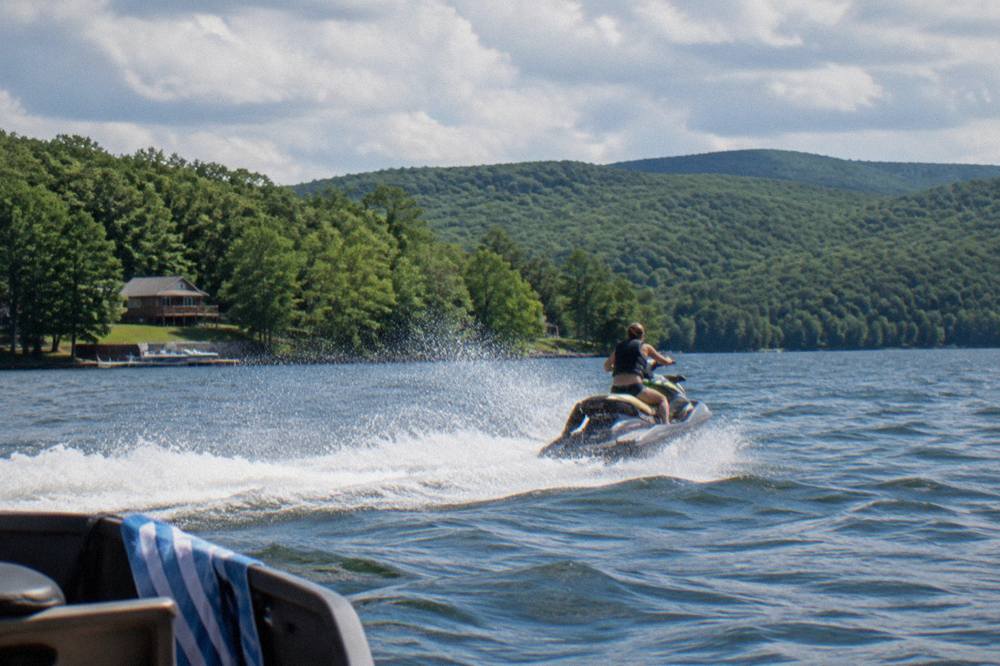
Personal watercraft may not operate between 11 a.m. and 4 p.m. on Memorial Day weekend, meaning the Saturday, Sunday and holiday Monday, and on Saturdays, Sundays and holidays from July 1 through Labor Day. Outside those windows, and on weekdays in July and August, PWC may run during daylight. The ban exists to thin out midday traffic when the lake is at its busiest.
This is the single rule that most changes a visitor's plan, and it is specific enough to be worth memorizing. The state agency exemption aside, every PWC on the lake is off the water during those afternoon blocks on peak days. The morning window before 11 is when the water is calmest anyway, and experienced riders treat the restriction as a scheduling tool rather than a punishment: out early, off by late morning, lunch, then back out after 4.
Planning a rental around quiet hours means booking a machine for a morning block or a late-afternoon block, not a midday one. Ask the rental operation which blocks it schedules in July and August, because the reputable ones build their day around the ban already. Weekday riders face no midday restriction at all, which is one quiet argument for a Monday-through-Thursday trip; the comparison in the best time for boating on Deep Creek Lake covers the rest of that calendar.
Riders should also know that PWC operation is illegal between sunset and sunrise outright, a stricter rule than the general night-running provisions for other vessels. There is no evening jet ski session after dark, full stop.

The fast water is the main basin, away from the 100-foot shoreline margin where every vessel runs at no-wake speed. PWC must additionally hold 6 knots or slower within 100 feet of another vessel, the shore, a pier, a bridge or people in the water. South of the Deep Creek Lake Bridge and below the Glendale Bridge, the coves narrow and the no-wake math leaves little room to run.
The geography matters more here than on most lakes. The northern tip around McHenry Cove holds the rentals, restaurants and resort traffic, and it is congested in proportion. The main basin south of the bridge is where a rider finds straight-line room. Below the Glendale Bridge the character shifts to quiet coves and sailboats, terrain that suits a pontoon or a kayak far better than a jet ski. The Chamber's lake geography summary describes exactly this three-part layout, and it is honest advice for anyone choosing a machine to match a part of the lake.
Speed itself is not the limiting factor; distance is. There is no general lake-wide speed limit beyond the no-wake zones and the PWC hour rules, with hazards marked by buoys. What a rider feels is the constant obligation to back off near anything floating, moored or swimming. Riders who accept that rhythm enjoy the lake; riders who fight it meet Natural Resource Police, who patrol the water actively in summer.
A jet ski is a poor tool for the cove tips where kayakers gather. If your group's day is split between paddling and riding, the split guide at kayak and paddleboard options on Deep Creek Lake covers the calm-water end of the lake in detail.
Funtime Watersports in Thayerville is the rental operation that lists jet ski rental alongside its pontoon tours, priced by the hour, half day or full day, with a captain add-on the operator lists at about $59 per hour. Its tours list at $34 for adults 16 and up, $16 for children 3 to 15, under 3 free, on the operator's own page. Lake Life Boat Rentals in McHenry rents watersports boats from about $1,296 per day, taxes extra.
Both are booked directly with the operator, and both publish their own prices, which change; confirm on the operator's page before planning around a figure. Funtime Watersports sits at 20294 Garrett Highway in the Thayerville end of the lake, recommends reservations, and runs a summer season. Lake Life Boat Rentals at 1899 Deep Creek Drive in McHenry requires reservations, runs roughly mid-May to mid-October, and rents full days from 9 a.m. to 5 p.m. with pontoons from about $524 and ski boats from about $681 per day as listed.
The Wisp Resort concession at the State Park handles guided pontoon tours plus kayak, SUP and tube rental rather than jet skis, so a mixed group can split its morning between a ride and a paddle even though the machines come from different docks. The full rental landscape, including pontoon pricing, is in the Deep Creek Lake boat rental guide.
| Operation | Based At | What It Rents | Booking |
|---|---|---|---|
| Funtime Watersports | Thayerville, south end | Jet ski by hour, half or full day; pontoon tours | Direct, reservations recommended |
| Lake Life Boat Rentals | McHenry, north end | Watersports boats, ski boats, pontoons, full day | Direct, reservations required |
| Wisp Resort Lake Adventures | State Park beach | Kayaks, paddleboards, tubes; guided pontoon tours | Direct, reservations required |
| Deep Creek Paddle Co | Delivered to you | Kayaks, SUPs, fishing kayaks | Direct, online |
One caution that applies across the board: a rental operation may set its own age or experience floor above the state minimum, and many do for insurance reasons. The state rule is a floor, not a promise.
The operator must wear a U.S. Coast Guard approved life jacket, the machine must carry a kill switch lanyard or self-circling device that the operator clips on, and the Maryland PWC regulation sticker must be on the craft. Operation between sunset and sunrise is illegal. Within 100 feet of vessels, shore, piers, bridges or people in the water, the machine holds 6 knots or slower.
None of this is optional gear-shop advice; it is the enforcement checklist. The life jacket rule for PWC is a wear rule, not a carry rule, which distinguishes it from the standard for most other vessels. The kill switch exists because a fallen rider without one leaves an unsteered machine circling a swimming area, and officers look for the lanyard clipped to the rider rather than tucked in a storage bin.
The 6-knot proximity rule deserves emphasis because it is stricter than the general no-wake rule that applies to other boats, which requires no-wake speed within 100 feet of shoreline, bridges, piers, docks or other vessels. A jet ski approaching a swim raft, a kayak or an anchored pontoon slows to a crawl well before it feels necessary. Riders who internalize the hundred-foot bubble have no trouble; riders who treat it as a suggestion collect the lake's most common citation.
| Rule | PWC Standard | Other Vessels |
|---|---|---|
| Proximity speed | 6 knots or slower within 100 ft | No-wake within 100 ft of shore and structures |
| Life jacket | Worn by operator | Readily accessible |
| Hours | Daylight only, plus the midday summer ban | Night running allowed with proper lights |
| Minimum operator age | 16 | Certificate rules vary by birth date |
| Noise | 88 dB at idle, no cutouts | Same lake standard |
Renters should also expect the invasive-species conversation. A person may not place a vessel or equipment carrying attached aquatic plants or prohibited organisms into state waters, and DNR advises Clean, Drain, Dry with at least 48 hours of drying. A rental operation handles this for its own fleet, but anyone trailering a personal machine between waterways should read the DNR invasive species page for Deep Creek Lake before launching.
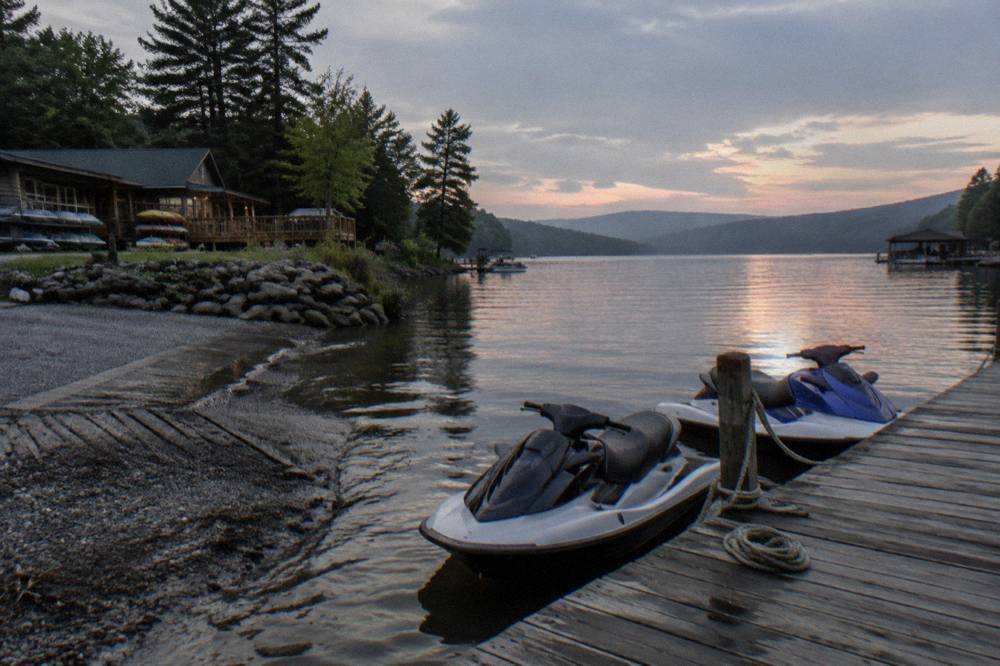
Stay in McHenry, where the jet ski and watersports rental cluster sits, so you are minutes from the docks and inside the morning ride window before the 11 a.m. ban. LakeFront Lodge is a lodging option in the McHenry area near the north-end launch and rental scene, Wisp Resort is a full-service option about 0.6 miles from the lake (an 11-minute walk per its listing), and The Garrett Inn in Oakland sits a short drive south.
Matching the bed to the ride window is the quiet optimization most groups miss. A midday ban means the valuable water hours are 8 to 11 a.m., and every minute of that window spent driving from a distant rental is a minute of flat morning water wasted. Staying in McHenry also puts the State Park beach, the Wisp concession's kayak and tube rentals, and the restaurants of the northern tip within a short orbit of the same room.
For a group splitting its days between the Thayerville rental dock and the northern basin, the drive between the ends is short enough that either base works, and Wisp Resort adds the advantage of being the operation whose concession runs the State Park beach rentals and pontoon tours, so a single property anchors both halves of a mixed water day. Budget-minded riders closer to the south end can look at The Garrett Inn in Oakland, about a three-minute drive from the lake per its listing.
McHenry
Lodging in McHenry, at the north end of the lake near the rental docks and the Wisp concession.
Check ratesThe wider lodging picture, including the properties closest to the State Park launch, is covered in the stay guide linked above; this section is only about the ride-window arithmetic.
A jet ski day on Deep Creek Lake is priced by the rental block rather than a flat day rate: Funtime Watersports lists rentals by the hour, half day or full day, with pricing confirmed on its own page at booking. The surrounding costs are small, since the rental operation handles the launch for its own fleet. A guided pontoon tour adult ticket, by contrast, lists at $34 with the same operator.
The honest framing is that a PWC day costs what the block costs, plus fuel handling per the rental terms, plus whatever your group does in the banned midday window. That midday gap is where the secondary spending lives: lunch, the State Park beach, a kayak hour from the Wisp concession at the listed $19 per hour, or a tube rental at $9 per day as the operator lists it. Groups that plan the 11-to-4 gap deliberately spend less and enjoy more than groups that discover it at the dock.
| Cost Item | Listed Figure | Notes |
|---|---|---|
| Jet ski rental | By hour, half day or full day | Confirmed on the operator's page |
| Captain add-on | About $59 per hour | As listed by the operator |
| Guided pontoon tour, adult 16+ | $34 | As listed by the operator |
| Tour child 3 to 15 | $16, under 3 free | As listed by the operator |
| Kayak hour, State Park beach | $19 | Wisp concession listing |
| Tube rental, State Park beach | $9 per day | Wisp concession listing |
| Boat launch at the State Park | A fee applies per launch | See the official DNR fees page |
Prices change and seasons shift; treat every figure here as the operator's own listing, to be confirmed before you plan around it. The launch fee and any State Park pass costs are on the DNR fees page, which is the authority that prints them.
Bring a photo ID, whatever certificate documentation your birth date requires, a towel and dry layer, sun protection rated for reflection off the water, closed-toe footwear that can get wet, and a plan for the midday ban. The rental supplies the machine, the life jacket and the safety briefing. Water, snacks and a dry bag for keys round out the kit, since the ride windows are short and the gaps between them are long.
The documents matter more than the gear. A rider who cannot demonstrate age or certificate standing loses the rental block, and the desk is right to enforce it. Everything else on the list is comfort: the lake sits at 2,462 feet of elevation in full pool, the weather turns fast in the Garrett County hills, and a wet rider at elevation gets cold sooner than the August calendar suggests.
The plan for the gap is the item people forget. From 11 to 4 on a peak Saturday you are off the water by law, so the day's shape becomes morning ride, midday beach or lunch, late-afternoon ride. The packing guide at what to bring for a day on Deep Creek Lake covers the broader lake-day kit, including the swimming and picnic side of that midday block.
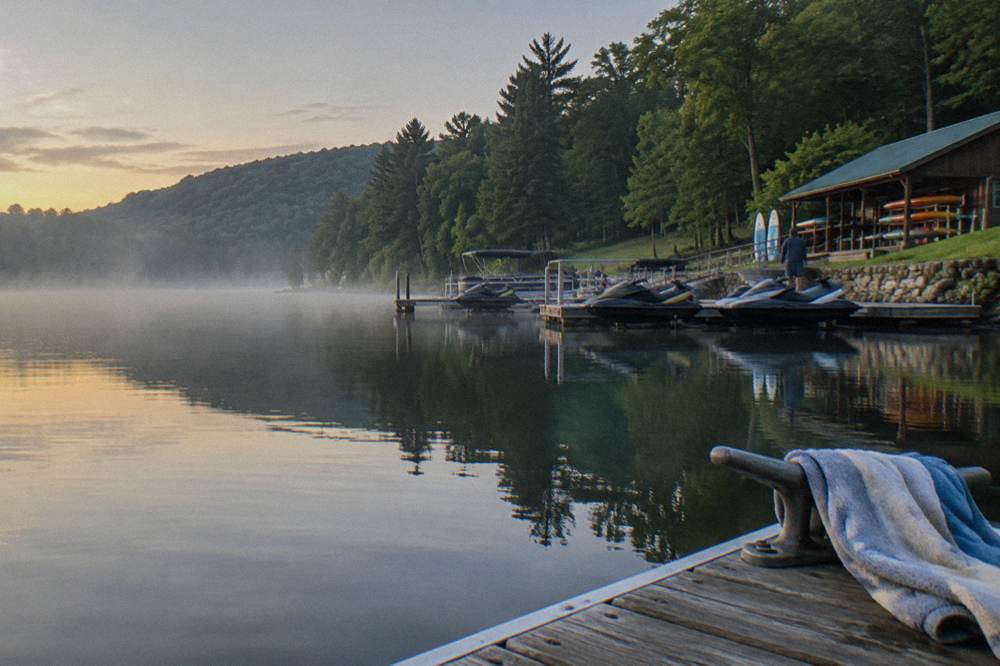
A jet ski suits a confident adult rider who wants short, fast windows on open water and can work around the midday ban; a pontoon suits a family that wants the whole day and the whole lake; a kayak or paddleboard suits anyone who wants the coves and needs no certificate at all. On rule density alone, the PWC carries the most obligations per hour of fun of anything rented on Deep Creek Lake.
That is not an argument against renting one. The morning water on the main basin is genuinely good, the machine is the fastest way to feel the lake's scale, and for a group of certified adults the weekend ban is a scheduling detail. But a family with teenagers under 16, or a group that wants to swim off the boat midday, will get more hours per dollar from a pontoon, where the captain add-on and the whole-day format match how the lake is actually used.
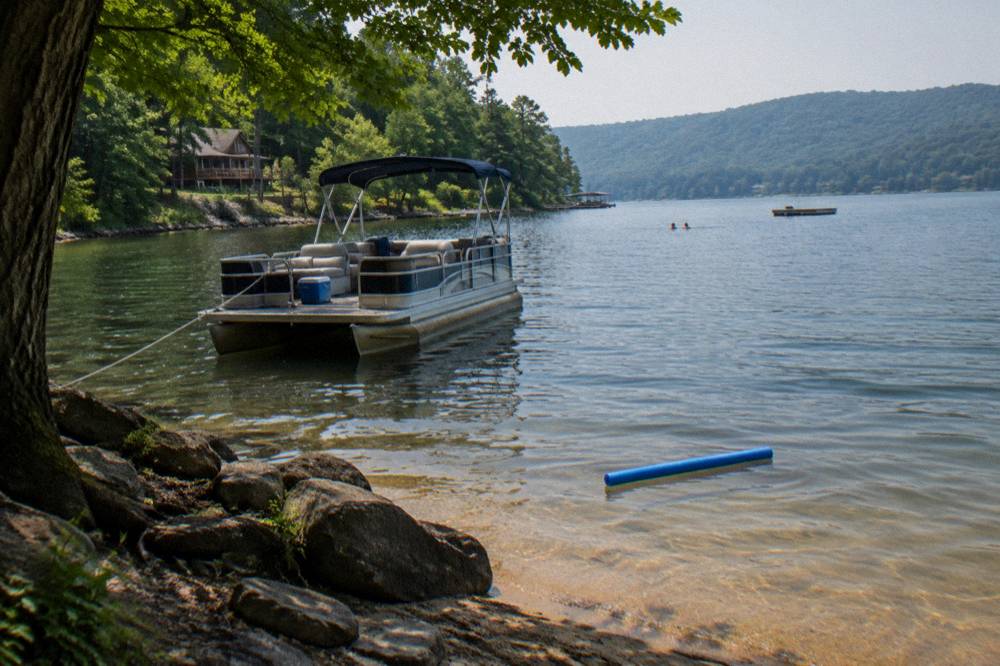
| If Your Group Wants | Better Fit | Why |
|---|---|---|
| Fast solo riding in short windows | Jet ski | Speed and agility, but hour bans and age floor apply |
| A full day with swimming and lunch | Pontoon | No midday ban, whole-lake range, group capacity |
| Cove exploring with no paperwork | Kayak or SUP | No certificate, quiet coves suit paddling |
| Towing tubes and wakeboards | Watersports boat | Power and seating for a towing crew |
| A guided hour with zero effort | Pontoon tour | Captain included, tours run about an hour |
For the deeper comparison, including pontoon sizes and rental pricing across the lake's operations, start with the pontoon tour and rental guides on the Deep Creek Boat Tours site, beginning with the guided pontoon tour guide and the pontoon rental guide linked across this site.
The jet ski rental season runs the summer, with the lake's rental operations generally winding down between mid-September and mid-October; Funtime lists a summer season and Lake Life lists roughly mid-May to mid-October, so confirm the exact closing date with the operator before a fall trip. The PWC hour rules apply all season, and the State Park's public docks come out in stages through late fall, with private docks required out of the water for winter.
Fall is the sneaky-good window that the rules make attractive. Weekdays in September carry no midday ban, the water is still swimmable early in the month, and the foliage crowd thins the boat traffic. The county's color typically peaks in the second or third week of October, after most rental fleets have closed, so the riding-and-foliage combination really only works in that early-fall band. Check the operator's page for this year's dates.
Winter closes the boating chapter and opens the ice one; the lake is Maryland's premier ice-fishing destination when conditions allow, and the state park gate closes to vehicles during snowmobile season. Anyone curious about the cold-water half of the year can start with ice fishing on Deep Creek Lake.
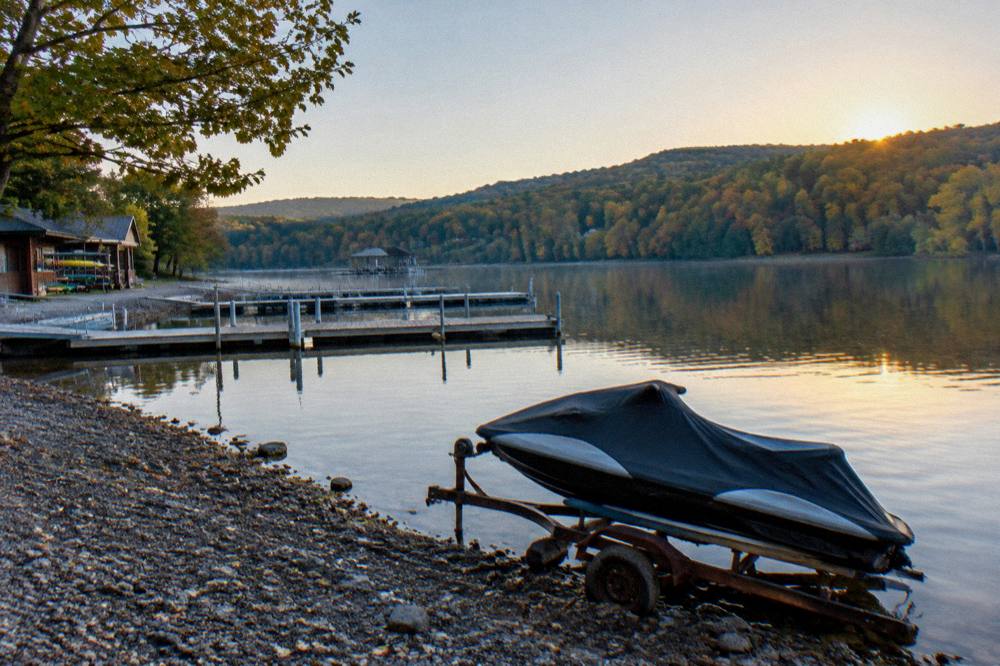
For lodging that keeps you near the morning ride window at either end of the lake, LakeFront Lodge offers lodging in the McHenry area close to the northern rental cluster, and the stay guide linked earlier covers the full range of options from Oakland to the State Park boundary.
McHenry, north end of the lake
Full-service resort 0.6 miles from the lake (11-minute walk per the listing); the Wisp concession runs the State Park pontoon tours.
Check ratesSixteen, with no supervision exception. A rider under 16 may ride as a passenger on a machine rated for two but cannot operate one, even with an adult aboard.
You need a boating safety education certificate if you were born on or after July 1, 1972. Renters can often satisfy the requirement through the rental operation's safety-sheet process; confirm with the desk what it accepts for a PWC.
Daylight only, and never between 11 a.m. and 4 p.m. on Memorial Day weekend or on Saturdays, Sundays and holidays from July 1 through Labor Day. Weekdays outside those dates have no midday restriction.
Funtime Watersports in Thayerville lists jet ski rentals by the hour, half day and full day, booked directly with the operator. It also runs one-hour pontoon tours.
Within 100 feet of another vessel, the shore, a pier, a bridge or people in the water, a PWC must hold 6 knots or slower. The general no-wake rule applies within 100 feet of shoreline and structures lake-wide.
Yes, and it must be worn, not merely carried. The operator must wear a U.S. Coast Guard approved life jacket, and the machine must have a kill switch lanyard or self-circling device in use.
Before you go, the pick for this guide:
The Garrett Inn
About 2.4 miles (3 minutes by car) from the lake per the listing.
Check rates →