Can You Ice Fish On Deep Creek Lake?
Yes, Deep Creek Lake is Maryland's premier ice fishing destination. Here is when the lake freezes, what the ice safety guidance says, what you can catch, and how to plan the trip.
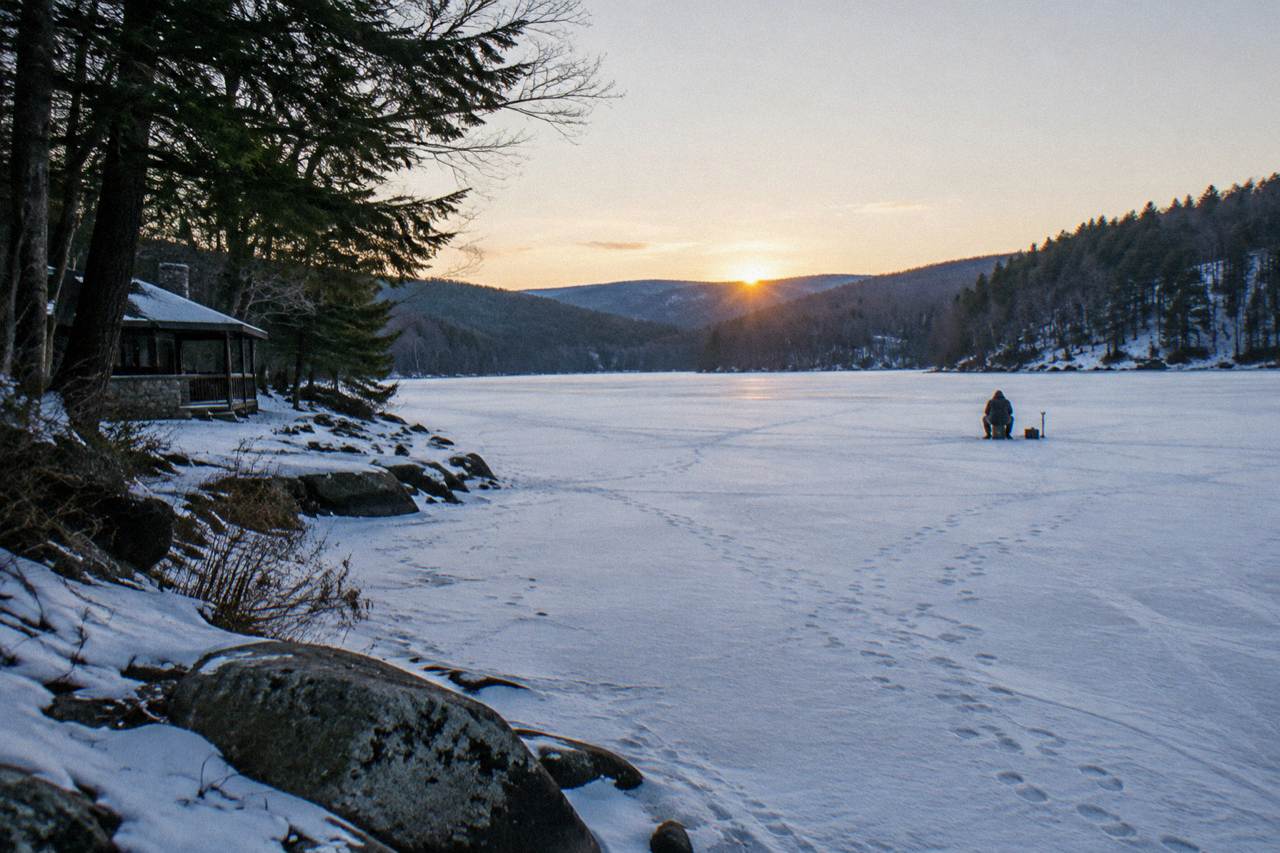
A hard freeze turns Maryland's largest impoundment into a different lake. Boats come off the water, the public docks come out in stages through late fall, and once the ice thickens, anglers walk onto the surface of Deep Creek Lake with augers and tip-ups. The Maryland Department of Natural Resources calls the lake the state's premier ice fishing destination when conditions allow, and the Garrett County Chamber is blunt about the winter: the lake does not shut down, it changes sports. If you have ever wondered whether the ice fishing here is real, it is, and it draws people from across the mid-Atlantic every cold winter.
Yes, ice fishing on Deep Creek Lake is a well established winter activity, and the Maryland Department of Natural Resources describes the lake as the state's premier ice fishing destination when the weather allows. The opportunity is real and popular, but it depends on conditions producing enough ice. The main targets through the ice are yellow perch, walleye and bluegills, with bass, crappie and northern pike also caught when conditions cooperate. In a normal cold winter the ice typically forms in late December or early January and can support fishing into February, a season of roughly two months in good years. No guide or rental operation runs ice trips for you, so this is a self-planned outing.
That last point matters for planning. Summer at Deep Creek Lake is full of guided pontoon tours and boat rentals, and the same outfitters that run kayak and paddleboard fleets in July have nothing to sell you in January. Ice fishing here is a bring-your-own-gear affair: you drill your own holes, read your own electronics or none at all, and make your own judgment about the ice. That independence is part of the draw for the people who come back every winter.
The lake supports the activity because of its shape and size. At 3,900 acres, 13 miles long with 69 miles of shoreline, it freezes unevenly, and shallow coves lock in safe-looking ice weeks before the main basin does. That unevenness is exactly why the safety question, which we cover below in detail, dominates every conversation about this sport on this lake.
When Does Deep Creek Lake Usually Freeze?
Deep Creek Lake usually freezes over in a normal cold winter, with ice typically forming in late December or early January. In a good season, the ice lasts long enough to support ice fishing through February, which means roughly two months of fishable ice for anglers hoping to get out on the lake. Garrett County sits high in the mountains of western Maryland, cold enough that the lake regularly freezes while lakes elsewhere in the state stay open. Shallow coves firm up first, the main basin follows, and the season's length depends entirely on the weather. Maryland DNR does not publish a freeze date or a season schedule because there isn't one to publish.**
The pattern is consistent enough that local anglers plan around it. Early ice, usually the safest and most productive window for panfish, tends to come after a stretch of sustained sub-freezing weather with little snow, since snow blankets the ice and slows further thickening. Midwinter brings the thickest ice. By late February, longer days and sun angle start working against the surface even when air temperatures stay cold.
Winter is also when the lake's operations genuinely change. The State Park's main gate is closed during snowmobile season, from December 15 to March 15, and winter visitors park at the Discovery Center instead. The Chamber's standing advice for anyone checking conditions is simply to call the State Park at 301-387-5563 before you go. Lake levels are managed within a permitted band through the winter too, which is one more reason the ice can differ from cove to cove.
Is The Ice Ever Officially Certified Safe?
No. Maryland DNR does not measure ice thickness on Deep Creek Lake and does not certify any ice as safe. There is no state agency stamp of approval, no posted green light, and no official report you can check from home. Every go or no-go decision is yours. The DNR guidance is direct: no ice is 100 percent safe, never go alone, always tell someone your plans, and test thickness in multiple spots with an auger or spud bar because conditions change daily.**
The widely shared minimum in the DNR-linked guidance is 4 inches of clear, solid ice for foot travel and ice fishing, measured in several places, not one. New ice is often stronger than old ice, so a fresh cold snap can produce better ice than a thicker-looking but weathered sheet. Weak spots form over springs, around bubbles, near currents and around any moving water, and Deep Creek Lake has those hazards, which is why local anglers treat each cove as its own question.
The rest of the standard kit is common sense that earns its keep here: wear a life jacket, carry ice picks and rope, and keep spread out rather than crossing in a group along one line. If you want the broader context on how the lake is managed in winter, our page on Deep Creek Boat Tours covers the summer side of the same water, and the drawdown piece below explains what happens to the level under the ice.
What Fish Can You Catch Through The Ice?
Yellow perch, walleye, and bluegills are the bread and butter of Deep Creek Lake ice fishing, and they are the species most anglers target through the ice. Maryland DNR also lists the lake as known for large panfish plus abundant walleye and smallmouth bass, so those fish round out the realistic catch list for anyone drilling holes here. Northern pike over 40 inches are caught regularly in the open-water season, and pike, crappie, chain pickerel and both bass species also move under the winter ice. Panfish generally cooperate most reliably through the ice, while walleye are the marquee fish for anglers willing to fish low-light periods.**
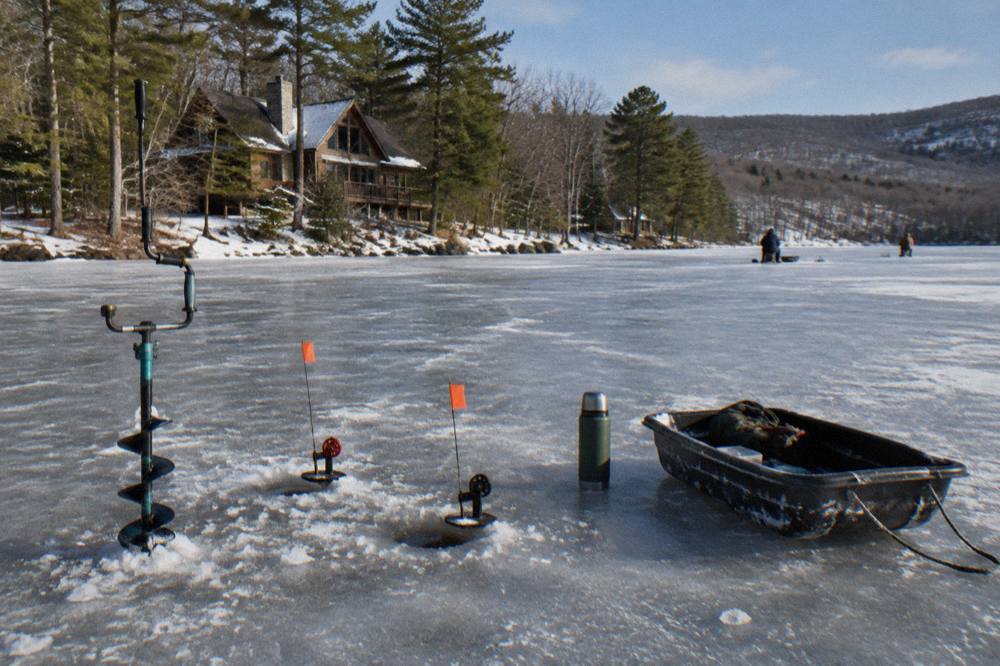
The species list matters because it shapes tactics. Yellow perch school over weed edges and drop-offs and will take small jigs tipped with minnows or spikes all day. Bluegills and pumpkinseed hold tighter to structure and go smaller and subtler. Walleye feed hardest at dawn and dusk around points and transition areas, which is why many ice anglers here set tip-ups for walleye while actively jigging for perch between flags.
| Species | Ice season reputation | Typical approach |
|---|---|---|
| Yellow perch | Primary target, schools are reliable | Small jigs with minnows or spikes over weed edges |
| Walleye | Marquee fish, low light is key | Tip-ups or jigging at dawn and dusk near points |
| Bluegill and pumpkinseed | Steady panfish action near structure | Micro jigs, waxworms, subtle presentations |
| Crappie | Caught when located, often with bluegills | Small minnows suspended over cover |
| Northern pike and pickerel | Opportunistic through the ice | Large live bait on tip-ups, expect bites near baitfish |
One rule from open-water season carries into the tail end of the ice season: walleye harvest is closed March 1 through April 15, with the open season running April 16 to the end of February, five fish daily and a minimum of 15 inches with a protected slot between 18 and 21 inches. Practically, most of the ice season sits inside the open season, but a late-ice March trip means catch and release for walleye. For the full picture on species and seasons through the year, see our guide to fishing on Deep Creek Lake, and DNR's own lake page has the authoritative detail on Deep Creek Lake fishing.
Where Do Anglers Access The Ice?
The practical winter access point is Deep Creek Lake State Park on the east side of the main basin, where you park at the Discovery Center between December 15 and March 15 because the main gate is closed for snowmobile season. From there, anglers walk or sled onto the ice near the park's shoreline. Shoreline access for anglers generally runs through public access points, and the State Park is the primary one. Beaching a boat rule and summer launch logistics are irrelevant in January, but the park remains the hub.**
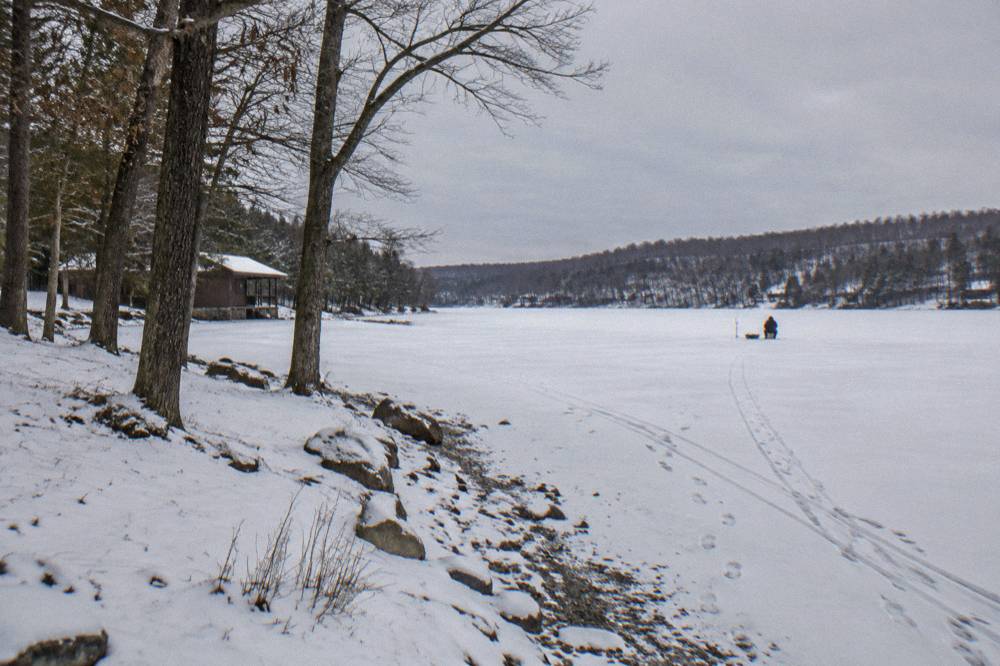
A few spatial realities shape where people actually fish. The lake's northern tip near McHenry, with its coves and boat rental docks, is a busy summer zone that goes quiet and private-feeling in winter. The main basin below the Deep Creek Lake Bridge, along the State Park shore, draws the most visible ice fishing traffic because access is public and the contours are known. South of the Glendale Bridge, quiet coves that hold sailboats and kayaks in summer can freeze early and hold perch, but most of that shoreline fronts private property, so access is limited to what you can reach from permitted points.
Two summer-specific closures matter if you fish near the park: the ranger docks and the swim area at the State Park are closed to fishing, a rule that applies under the ice season too since those structures sit in those waters. And remember that docks, public and private, come out of the lake through late fall, so do not count on any dock as a landmark or platform. Our guide to boat ramps and launching at Deep Creek Lake covers the same shoreline from the summer side.
What Gear And Preparation Does An Ice Trip Take?
The core kit is an auger or spud bar to test and drill, a float suit or life jacket, ice picks, rope, a sled to haul gear, rods or tip-ups, and live bait or small jigs sized for perch and panfish. None of it is available for rent at the lake in winter, since the local outfitters that rent kayaks, paddleboards and pontoons in summer shut their rental seasons down by mid fall. You bring everything, or you drive in with a group that has it.**
That seasonal shutdown is the biggest planning surprise for visitors who know Deep Creek Lake in summer. The outfitters along Garrett Highway are summer businesses. When their boats come off, there is no shop on the lake renting augers the way a ski area rents skis. The nearest full-service tackle and gear options are outside the immediate lake area, so a checklist before you leave home is worth the ten minutes.
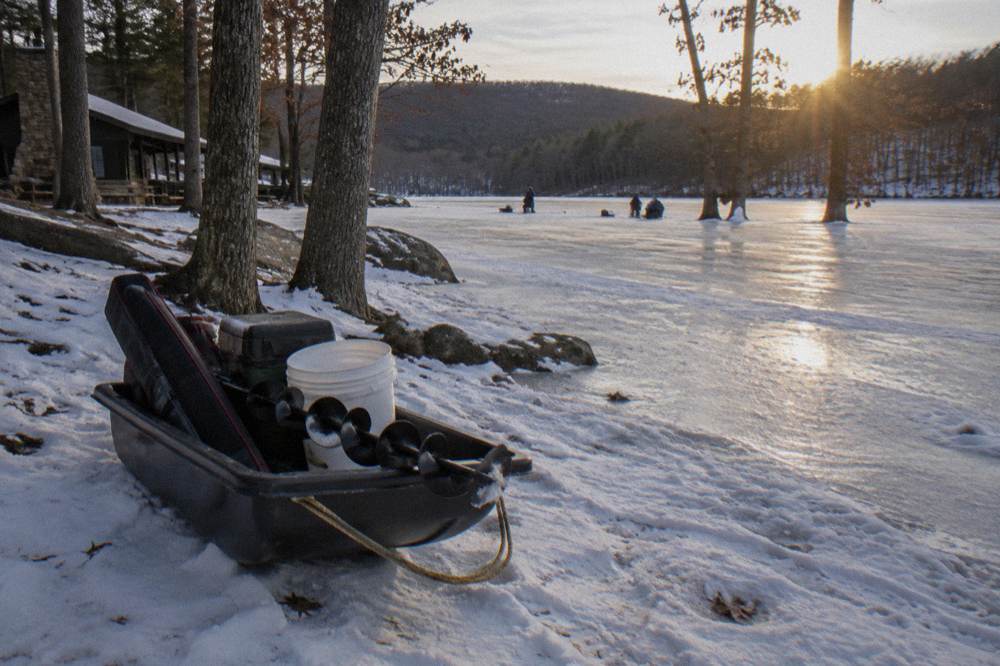
| Item | Why it matters here | Notes |
|---|---|---|
| Auger or spud bar | DNR advises testing thickness in multiple spots | 4 inches of clear ice is the common foot-travel minimum |
| Life jacket or float suit | DNR ice safety guidance applies to all ice users | Wear it, do not stow it |
| Ice picks and rope | Self-rescue and assisted rescue | Kept on your body, not in the sled |
| Sled | Hauling gear from the Discovery Center lot | Distances on the snow can be long |
| Rods, tip-ups, small jigs | Perch, bluegills and walleye | Live bait such as minnows and spikes is standard |
| Charged phone, told plans | Never go alone, inform someone | Cell coverage on the ice can vary by cove |
Clothing deserves its own sentence: mountain winters in Garrett County run colder than the rest of Maryland, and standing still on ice for hours is a different cold than skiing through it. Insulated boots, layered hands and a windproof outer layer separate a good day from a short one.
Where Should You Stay For An Ice Fishing Trip?
Oakland, on the south end of the lake, is the most practical winter base for ice fishing: The Garrett Inn sits about 2.4 miles, three minutes by car, from the lake per its listing, and the budget-friendly Baja Motel is also in Oakland, a short drive from the Thayerville end. On the north end near the State Park side of the lake, Lake Pointe Inn in McHenry is close to the lake and the State Park, with a free full breakfast and an adjacent golf course per its listing.**
Winter rates and availability at lake-area lodging behave differently from the summer peak, when rooms near the water fill for boating weekends. In ice season, midweek stays are easy and weekend crowds cluster around snow conditions rather than fishing reports. Oakland has the added advantage of being a real town with food and supplies, useful when your day starts before dawn.
The Garrett Inn
Oakland
About 2.4 miles (3 minutes by car) from the lake per the listing.
Check ratesBetween the two ends of the lake, choose by where you plan to fish. If the State Park side of the main basin is your access, McHenry keeps the drive short on snowy roads. If you are chasing early ice in the southern coves, Oakland is the better anchor. Either way, check road conditions on the drive up, since winter storms move through Garrett County quickly.
Do You Need A Fishing License Or Any Permit?
Yes, anyone age 16 or older needs a Maryland fishing license to fish Deep Creek Lake, which you can buy online or from a license agent before your trip. As for additional permits, the standard trout stamp rules do not add anything for ice fishing here. The lake is a put-and-take area with no special spring closure, so no seasonal fishing closure interrupts the ice season. Boating certificates and the summer launch fee questions simply do not apply once the boats are out of the water.**
The licensing point is straightforward, but it is worth separating winter from summer in your head. A summer visitor juggling a launch fee, a lake use permit question and a boating safety certificate has three things to sort. An ice angler has one: the fishing license, plus whatever the daily walleye regulations mean for what lands on the ice beside you. If you are also planning a summer trip to the same water, our article on where you can launch a boat at Deep Creek Lake explains the ramp side, and the DNR fee page at dnr.maryland.gov carries current launch and park fees for the rest of the year.
One winter habit worth copying from locals: save the State Park number, 301-387-5563, in your phone. The Chamber recommends calling for conditions, and in ice season that call answers gate status, snow cover and whatever the recent weather has done to the access areas.
What Does The Lake Level Do Under The Ice?
Under the ice, the lake level continues to be managed within a permitted operating rule band set under Maryland oversight, and Brookfield Renewable, the operator of the hydroelectric plant, strives to keep the level inside that band even in winter, with allowances made for periods of high runoff or drought. Through winter the level generally trends lower than the summer full pool of 2,462 feet, which can leave the ice sitting above the waterline at the edges in some spots. No month-by-month drawdown table appears in the primary public sources, so treat any specific winter figure you hear elsewhere with caution.**
For ice anglers the practical effect is edge ice: when the level drops under a frozen sheet, the ring of ice near shore can lose contact with the water below and weaken, even when mid-lake ice is thick. It is one more reason the DNR advice to test thickness in multiple spots is not a formality on this particular lake. Anglers who also boat here in summer will recognize the same dynamics from the other side; our article on when they lower Deep Creek Lake covers the drawdown in detail.
Common Questions About Ice Fishing On Deep Creek Lake
Can You Ice Fish On Deep Creek Lake?
Yes. The Maryland DNR describes Deep Creek Lake as the state's premier ice fishing destination when the weather allows, with a typical season from freeze-up in late December or early January into February. It is a self-guided activity, so you bring your own gear and make your own ice safety calls.
When does the ice usually form on Deep Creek Lake?
In a normal cold winter, ice typically forms in late December or early January, and a good winter supports fishing through February, roughly a two month season. Shallow coves freeze first and the main basin follows. There is no official freeze date, so call the State Park at 301-387-5563 for current conditions.
How thick does the ice need to be?
The guidance in DNR-linked ice safety material is a minimum of 4 inches of clear, solid ice for foot travel and ice fishing, tested in multiple spots with an auger or spud bar. Maryland DNR does not measure or certify ice thickness on the lake, and no ice is considered 100 percent safe.
What fish bite through the ice at Deep Creek Lake?
Yellow perch, walleye and bluegills are the mainstays, and the lake is known for large panfish and abundant walleye. Crappie, chain pickerel, northern pike and both bass species are also caught. Walleye harvest closes March 1 through April 15, which matters only for a very late-ice trip.
Can you rent ice fishing gear at the lake?
No. The lake's outfitters run summer rental and tour seasons for pontoons, kayaks and paddleboards and shut down by mid fall. Nothing on the lake rents ice augers or ice gear in winter, so bring everything with you or source it before you arrive.
Where do you park for winter access?
Deep Creek Lake State Park's main gate is closed during snowmobile season, December 15 to March 15, and winter visitors park at the Discovery Center. From there you can reach the shoreline and the ice on foot or by sled.
A winter trip to Deep Creek Lake rewards preparation more than most. The fish are there, the access is real, and the cold that empties the summer boat schedule is the same cold that builds the ice. Check the forecast, pack the picks, tell someone your plan, and call the park before you drive up. For the rest of the year on this water, the boating side of the lake waits at our guide to boating on Deep Creek Lake.
Staying over rather than driving up pre-dawn? Lake Pointe Inn in McHenry keeps you near the lake and the State Park, and on the south end of the lake, the Baja Motel in Oakland is a budget-friendly option a short drive from the Thayerville end.
Lake Pointe Inn
McHenry, near Deep Creek Lake State Park
Close to the lake and the State Park, with free full breakfast and an adjacent golf course per the listing.
Check rates